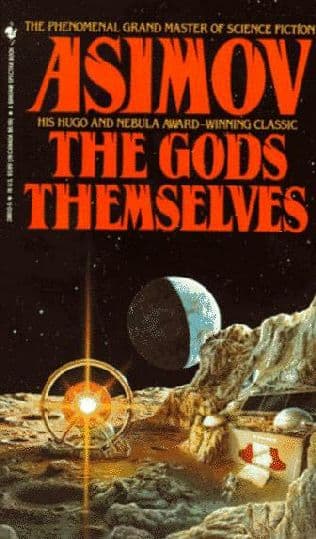
The Pump Won't Stop Itself
Asimov wrote *The Gods Themselves* in 1972, partly to prove he could write about aliens and sex — two things critics said he couldn't do. He succeeded at the first. The aliens of the para-Universe, with their tripartite biology and their melting-into-one reproductive cycle, remain some of the most genuinely *other* beings in science fiction. The sex is another matter. But the book's real achievement, the one that has aged into something almost unbearable to read in 2026, is its portrait of a civilization that knows an energy source is destroying the fabric of reality and cannot bring itself to stop using it. Hallam's Electron Pump is free energy, too cheap to meter, and the warnings come from people who are easy to dismiss — a disgraced radiochemist, a frustrated linguist, voices without institutional backing. The political economy of the Pump is the political economy of carbon, of algorithmic engagement, of any system whose benefits are immediate and diffuse while its catastrophic risks remain abstract and deferred. Asimov didn't predict climate change. He predicted something worse: the *structure* of how civilizations fail to act on existential warnings. The phrase "against stupidity, the gods themselves contend in vain" — Schiller, via Asimov's title — now reads less like literary allusion and more like policy analysis.
What Asimov got right about institutional science is startling in its specificity. Hallam is not a villain; he is a mediocrity who became powerful because he was standing in the right place when the anomaly appeared, and who then spent decades defending his status by conflating his reputation with the truth. Lamont's failure is not a failure of evidence but of politics — he cannot get published, cannot get heard, because the man he's contradicting controls the funding. In 2026, after decades of watching climate scientists be marginalized, after watching pandemic warnings go unheeded because they came from the wrong departments, after watching AI safety researchers be dismissed as alarmists by the companies building the systems, this dynamic is no longer speculative. It is Tuesday. Asimov understood that the obstacle to survival is not ignorance but incentive.
The book's blind spots are characteristically Asimovian. Women in the human sections are nearly absent; Selene Lindstrom on the Moon is given more agency than most Asimov women, but she still functions primarily as a conduit for Denison's ideas and a reward for his cleverness. The alien Dua is the most fully realized character in the novel — passionate, rebellious, desperate — and it is telling that Asimov could imagine a genderless being with more interiority than any human woman he ever wrote. The lunar society is conceived as a frontier outpost, vaguely libertarian, culturally homogeneous in a way that reflects the American space-enthusiasm of the early 1970s rather than anything resembling the multinational, commercially driven space development we actually got. There is no internet, no computational revolution, no sense that information itself might become the contested resource. The Pump is a physics problem; it never occurs to anyone that the real danger might be who controls the data about the Pump.