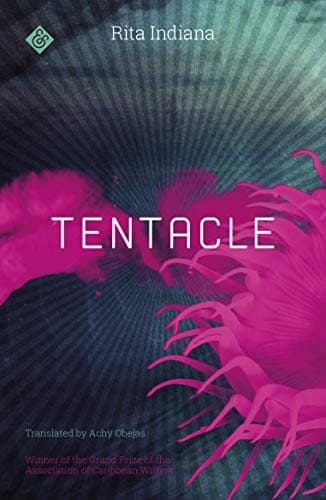
The Dead Sea Was a Prophecy, Not a Metaphor
Rita Indiana wrote *Tentacle* as if she were taking dictation from a future that hadn't quite decided how bad it wanted to be. Published in English in 2018, the novel offered a Caribbean dystopia where the ocean has died, coral reefs are memory, Haitian refugees are hunted by robotic border enforcement, and a mysterious substance enables bodily transformation across gender and time. It read, then, as maximalist speculative fiction — Afro-Caribbean spirituality braided with queer identity politics and ecological horror, all compressed into fewer than two hundred pages. In 2026, it reads like a status report with mythological footnotes. The mass coral bleaching events of 2023 and 2024, the worst ever recorded, turned Indiana's dead sea from literary conceit into something closer to projection. The Dominican Republic's escalating deportation campaigns against Haitians — accelerated in 2024 with industrial efficiency and rhetorical cruelty — map with uncomfortable precision onto the novel's robotic "collectors" that target fleeing Haitians with lethal force. Indiana didn't predict the specific technology. She predicted the disposition. The willingness. That turned out to be the harder thing to get right, and she got it right.
What the novel anticipated about gender-affirming technology is more complicated. Rainbow Brite, the drug that transforms Acilde's body in a single agonizing session, is pure science fiction — no incremental hormone therapy, no surgical recovery, just violent metamorphosis. It's tempting to read this as naïve, but Indiana wasn't writing about medicine. She was writing about desperation and the black markets that desperation creates. In a world where access to legitimate trans healthcare has become more politically contested in the United States and parts of Latin America since 2018, the novel's portrait of transformation happening outside institutional channels, painfully, in hiding, facilitated by someone operating in shadows — that's not dated. It's just relocated from the speculative register to the documentary one. What Indiana couldn't imagine, or chose not to, was the degree to which AI and algorithmic surveillance would reshape the specific texture of border enforcement and social control. Her robotic collectors are blunt instruments. The actual machinery of exclusion in 2026 is quieter, more bureaucratic, more diffuse. She wrote the violence loud. Reality turned the volume down and the frequency up.
The novel's temporal structure — jumping between a future Acilde, a contemporary Argenis, and historical Taíno and buccaneer timelines — embeds a thesis about Caribbean time that has only become more legible. Indiana insists that colonialism, ecological destruction, and spiritual resistance are not sequential events but simultaneous ones, layered into the same bodies and the same water. This felt, in 2018, like a formal experiment. It feels now like the only honest way to narrate a region where the IMF, the hurricane season, the sugar trade, and Vodou exist in the same sentence. The passages about Nenuco's family maintaining Taíno rituals in secret, about Esther Escudero wielding santería as political technology, about Malagueta using performance art to confront Dominican anti-Blackness — these hit differently after years in which Indigenous and Afro-diasporic knowledge systems have been increasingly cited in climate adaptation discourse, sometimes genuinely, sometimes as decoration. Indiana was not decorating. She was arguing that these systems are infrastructure, and that their erasure is part of the same catastrophe as the reef death.