The Blockade That Aged Into a Mirror
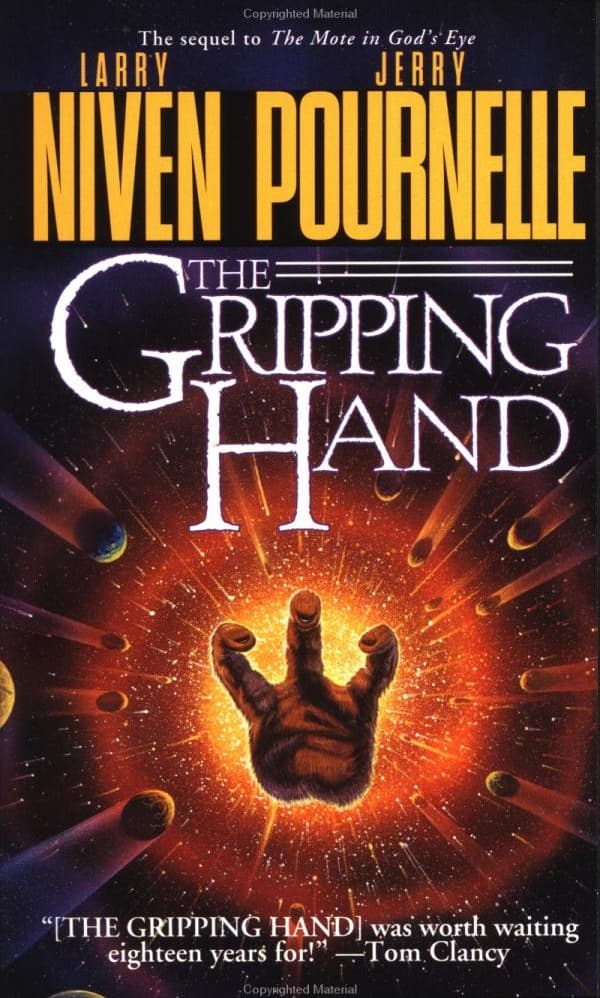
There is a particular flavor of science fiction that reads less like prophecy and more like a diplomatic cable written by someone who happened to be right about the wrong things. *The Gripping Hand* is that cable. Published in 1993 as the sequel to *The Mote in God's Eye* (1974) — not 1978 as sometimes misfiled — it returns to the Moties, a species whose defining characteristic is that they breed themselves into periodic civilizational collapse. The Empire of Man's solution to this existential threat is a blockade: contain the aliens behind a chokepoint, monitor them, and hope the problem stays bottled. Niven and Pournelle, writing in the immediate aftermath of the Cold War's end, produced a novel about containment doctrine applied to biology. In 2026, this reads less like space opera and more like a position paper on biosecurity, immigration policy, and the geopolitics of quarantine — subjects we now understand with an intimacy the authors could not have intended.
What the book gets right, almost uncomfortably so, is the economics of threat perception. Horace Bury, the reformed merchant prince turned intelligence asset, spends his chapters monitoring trade flows, inflation signals, and market anomalies for evidence of alien infiltration. This is essentially financial surveillance as counterterrorism — a methodology that barely existed in public discourse in 1993 but became the backbone of post-9/11 security architecture. The novel assumes that economic data is intelligence data, that the first sign of an existential threat will appear in commodity prices and shipping manifests. It was right. Where it stumbles is in its model of information flow: everything still moves through hierarchies, through admirals and viceroys and personal audiences with the Emperor. There is no network effect, no distributed information ecology, no possibility that a sixteen-year-old with a dataset could outrun the Imperial Intelligence apparatus. The Empire of Man has faster-than-light travel but no internet. This is the signature blind spot of its era.
The Moties themselves remain the novel's most durable contribution, and the most troubling. A species that cannot stop reproducing, whose every civilization ends in resource war and collapse, whose every faction is simultaneously negotiating and preparing for betrayal — they are, depending on your political sympathies, either a parable about Malthusian inevitability or a xenophobic projection dressed in exobiology. Niven and Pournelle clearly intended the former. They were writing in a tradition that took population dynamics seriously as a civilizational variable, inheriting from Malthus through Ehrlich, and they embedded it in a species whose tragedy is biological rather than moral. But in 2026, after decades of declining global fertility rates and the wholesale collapse of the population bomb thesis, the Moties read differently. Their crisis is not our crisis. The great demographic anxiety of our moment is not too many people but too few, not unchecked growth but stagnation and aging. The novel's central premise has been inverted by history, which gives it an unintended poignancy: the Moties are terrifying precisely because they represent a problem we no longer have and perhaps secretly envy.