The Fail-Safe That Wasn't Built by Committee
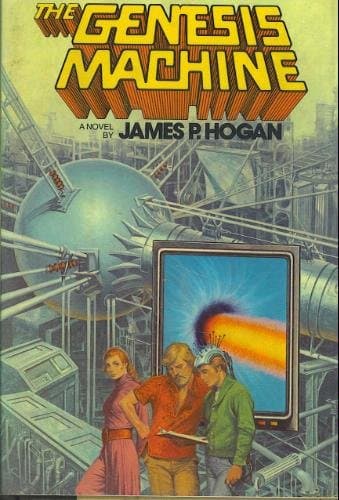
James P. Hogan's *The Genesis Machine* is, at its structural core, a fantasy about what happens when one sufficiently brilliant physicist is allowed to be right about everything. Published in 1978, it reads like a Cold War fever dream re-skinned with a different geopolitical alignment — China and an "Afrab" bloc versus the Western democracies — and then resolved by the invention of a weapon so total that it transcends weaponry altogether. Clifford, the protagonist, is the archetype Hogan would return to again and again: the lone rational man besieged by bureaucrats, vindicated by results. The novel's real argument is not about physics but about institutional failure — the claim that governments, militaries, and funding bodies are constitutionally incapable of handling transformative science, and that the only solution is to let the scientist retain final control. In 2026, with AI governance debates raging over exactly who gets to hold the kill switch on powerful systems, this reads less like fiction and more like a position paper from a very particular ideological camp. Hogan anticipated the core tension with eerie accuracy: a technology so powerful that its deployment framework matters more than the technology itself. What he could not anticipate is that the people building such systems would, in practice, be neither lone geniuses nor government committees but diffuse corporate entities answerable to shareholders and quarterly earnings calls.
The prescience is uneven but real. The brain-computer interface chapters, with Clifford learning to operate the BIAC system through focused mental modeling, land differently after a decade of Neuralink announcements and the slow, grinding progress of actual BCI research. Hogan got the concept right and the timeline impossibly wrong, which is the standard failure mode of hard SF optimism. The "k-astronomy" capable of real-time imaging of planetary interiors and distant objects without light-speed delay is pure wish fulfillment, but the underlying impulse — that a unified field theory would unlock observational capabilities we can't currently conceive — maps loosely onto the way gravitational wave astronomy has opened genuinely new windows since 2015. The geopolitical modeling is more interesting for what it reveals about 1978 than about 2026. Hogan imagined a world divided cleanly along racial and ideological alliance lines, with China as an expansionist military threat partnered with an Arab bloc. The actual 2026 landscape — with its shifting, transactional alliances, economic interdependence, and hybrid warfare — is messier and less legible than anything the novel permits. There are no cyberattacks in this book. No information warfare. No social media. The conflicts are kinetic and the diplomacy is formal, which now feels almost quaint.