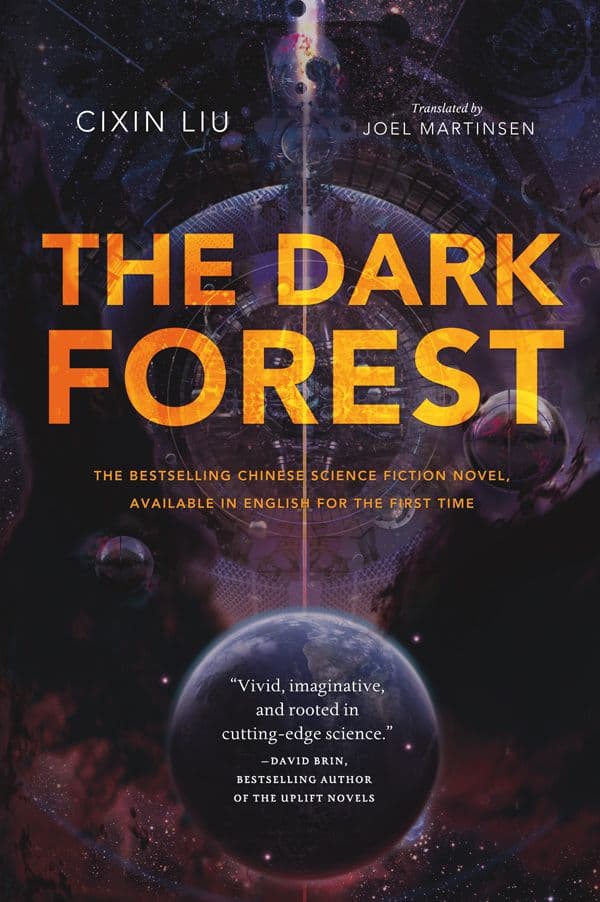
The Theorem That Mistook Itself for a Universe
Two axioms, two auxiliary concepts, one conclusion. Cixin Liu builds *The Dark Forest* the way a mathematician builds a proof: state your premises, derive your result, and leave the reader to decide whether the premises hold. The premises are these — "Survival is the primary need of civilization" and "Civilization continuously grows and expands, but the total matter in the universe remains constant" — and the derivation, carried out in a desert at night between two men holding lit cigarettes like rival stars, produces a universe where silence is the only survival strategy and exposure is a death sentence. "The universe is a dark forest. Every civilization is an armed hunter stalking through the trees like a ghost." The formulation is so clean it has escaped the novel entirely. It circulates as geopolitical shorthand, as AI alignment metaphor, as a way of thinking about platform competition. Liu did not write a story that became a theory. He wrote a theory that wore a story like a pressure suit.
What the novel anticipated was not any particular technology or event but a *mood* — the creeping sense, visible across international relations and technology governance alike, that communication itself is a vulnerability. The chain of suspicion, Liu's term for the recursive inability of civilizations to verify each other's intentions across distance, maps with uncomfortable precision onto the epistemic collapse of the 2020s: nations that cannot verify each other's AI capabilities, corporations that cannot audit each other's training data, platforms whose users cannot distinguish signal from adversarial noise. The Wallfacer Project — in which strategists must formulate plans entirely inside their own skulls because every external medium is compromised by the sophons — was published a decade before anyone used the phrase "end-to-end encryption debate" in a policy paper, and yet its logic is identical. The only secrets left are the ones that never leave a single mind. In 2008 this was a narrative device. By 2026, it describes the operational security doctrine of several actual governments. The Trisolarans, whose transparent thought processes make them constitutionally incapable of deception, regard human opacity with the revulsion one reserves for snakes. "This difference in mental transparency gives us all the more resolve to wipe out humanity." The novel treats the capacity for deception not as a moral failing but as an evolutionary advantage — possibly humanity's only one. That argument has aged into something sharper than Liu likely intended, given the current global appetite for AI systems that can read intent, predict behavior, and render the inner life legible to institutions.