The Hum of a Satellite Dish on a Rooftop in Colombo
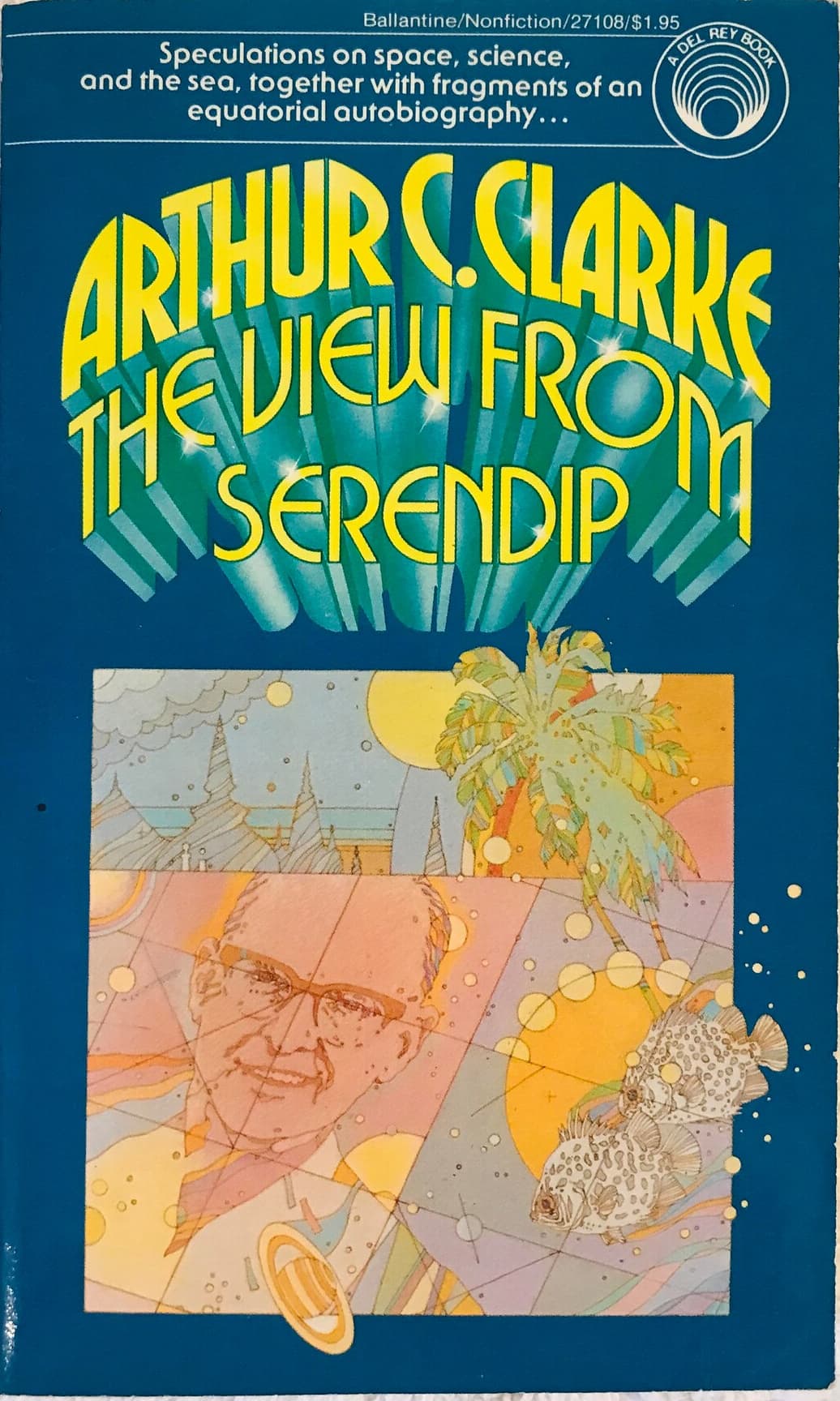
Arthur C. Clarke wrote *The View from Serendip* from the position of a man who had already won most of his bets. By 1978, geostationary communications satellites — which he had proposed in a 1945 paper — were operational infrastructure. The Apollo program had vindicated the dreamers of the British Interplanetary Society. He was living in Sri Lanka, a place he loved with the uncomplicated ardor of a man who had chosen his exile well, and the book radiates the confidence of someone watching the future arrive more or less on schedule. What makes it worth rereading in 2026 is not the confidence but the specific texture of what it got right, what it got sideways, and what it could not see at all. Clarke's prediction of a "global electronic information grid" enabling unprecedented communication and access to knowledge is, obviously, the internet — described here without the word, without the architecture, but with the social consequence almost perfectly mapped. His advocacy for educational satellites leapfrogging terrestrial infrastructure in developing nations anticipated the logic, if not the exact mechanism, by which mobile connectivity would transform India and sub-Saharan Africa decades later. The ATS-6 experiment he championed was a proof of concept for a world that now takes Starlink for granted. He understood that the demand for communication is essentially bottomless, and that this demand would pull technology forward faster than any government program.
The blind spots are instructive. Clarke's vision of the future is relentlessly material — rockets, food synthesizers, autonomous homes, satellite dishes — and almost entirely innocent of the informational and psychological crises that define our present. He imagined a world where more communication meant more understanding, where access to knowledge would dissolve superstition and tribalism. He did not imagine algorithmic radicalization, deepfakes, or the weaponization of the very connectivity he celebrated. His breezy dismissal of astrology and UFO credulity assumed that scientific literacy would advance in lockstep with technological capability. It has not. The chapter debunking the 1962 planetary conjunction panic reads as almost poignant now, in an era when conspiracy thinking has metastasized far beyond anything Clarke could have credited. His treatment of domestic servants in postcolonial Ceylon, written with the genial tone of a man who considered himself progressive, lands with a thud in 2026. He is not cruel, but he is untroubled in a way that reveals the assumptions of a particular kind of mid-century British expatriate. The absence of any sustained engagement with climate, ecological collapse, or resource depletion is the loudest silence in the book. Clarke's cosmos is vast and inviting; his Earth is a stable platform from which to launch.