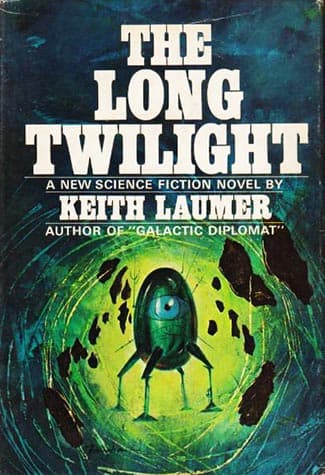
The Bullet That Would Not Stay Buried
There is a scene, buried deep in *The Long Twilight*, where a doctor examines a man's old wounds and finds them healing out of order — a three-week-old gash closing overnight, a century-old bullet scar reopening to expel a minié ball still lodged from some Civil War skirmish. The body is running its repairs backward, oldest injuries last, as though war were a queue and this particular flesh had been standing in it since 1863. Laumer doesn't dwell on it. One paragraph, then the plot moves on. But it's the exact image the rest of the book keeps circling without ever stating outright: that a man can carry a war in his tissue long after his mind has stopped carrying it in memory.
The premise underneath the pulp chassis is that a soldier of an ancient interstellar empire has been hiding on Earth for centuries, dying and reincarnating, forgetting and half-remembering, while his brother-in-arms hunts for him across time to drag him back to the fleet. Laumer gives the desertion a clean, almost embarrassingly simple justification: *"Better a live acorn than a dead forest."* A wife. A child. A barony of mud and grain. Weighed against eternal service to a doomed empire fighting an unwinnable war against an enemy called the Xorc, the man chooses the acorn. His brother calls it cowardice, calls it forgetting his duty to Ysar — the beloved, unreachable capital that opens the book in a fever-dream prologue of towers and yellow skies and ships launching "though it be at the end of time." The desertion is total. He does not send word. He does not explain himself to history. He just stops.
Laumer published this in 1969, which is not a fact I'm offering as context so much as an atmosphere the book seems to have absorbed without noticing. There is no draft-card burning here, no picket line, no political vocabulary at all — Laumer was a career pulp adventurer, not a protest novelist, and nothing in the prose suggests he intended commentary. But a warrior choosing exile and a quiet farm over an endless, ancestrally mandated war, framed not as failure but as the only sane choice available, is not a neutral image to have reached for that particular year. It's what a culture produces when the idea of walking away from a war has become thinkable again, even in a book with no interest in saying so directly.
The novel's other half is a congressional hearing, and it is, unglamorously, the better-written material. An engineer named Hunnicut has built a continent-spanning wireless power grid, and something is siphoning current from it — drawing off enough load to spin up a hurricane, black out a federal penitentiary, strand seven hundred inmates behind locks that fail open in the dark. The scene where Hunnicut tries to explain "field discontinuities" to a senator who wants villains — Russians, saboteurs, anyone indictable — reads less like 1969 techno-thriller filler and more like the transcript of any hearing in which a specialist tries to explain an unprecedented failure mode to an audience that has already decided the failure is either fraud or treason. Nobody in the room is stupid. Nobody in the room is listening. The senator doesn't want the truth; he wants a name to attach to blame, and Hunnicut doesn't have one, because the truth is stranger and slower and has no face yet.