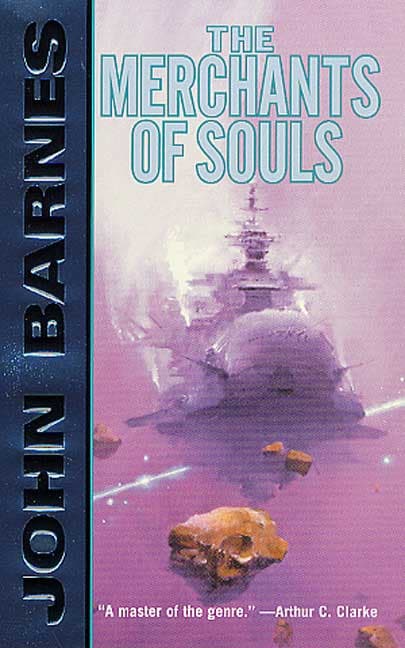
The Pleasure Machine Apologizes for Nothing
John Barnes published *The Merchants of Souls* around 2000, the third volume in a sequence that had been building, book by book, toward a question nobody in science fiction was asking with quite this much specificity: what happens when the technology of immortality becomes the raw material for an entertainment industry? The psypyx—a whole-brain recording that could, with luck, be coaxed back into a living body—was Barnes's device for getting there, and what he did with it anticipated the consent crisis of the 2020s with an accuracy that would be impressive if it weren't so depressing. "The neuroscientists' best guess is that the psypyxed personality being used in a game, or as entertainment, must feel as if it were in a dream controlled by somebody else, experiencing everything, unable to wake up, unable even to say 'Stop' or 'That hurts.'" That sentence was written before anyone had trained a language model on scraped human writing, before digital likenesses of dead actors were composited into new performances, before companies began marketing chatbots that simulate your deceased grandmother. Barnes's merchants are not villains. They are licensing committees. They are arguing, reasonably, that what sits in storage is data, not a person, and that data has always been exploitable. The knife is held by a definition.
The book's other anticipation is stranger and more complete. A quarter of Earth's population has "gone solipsist"—they believe nothing outside their apartments is real, that everything is generated by aintellects, and that the only difference between plugged-in entertainment and the world outside is that the latter is "a 'base' or 'default' program that wasn't supposed to be very interesting." Barnes wrote this before social media existed in any recognizable form. He wrote it before anyone had coined "terminally online." His solipsists are not psychotics; they are people making a rational inference from the quality of their simulated experiences versus the quality of their actual ones. Their friends cope by performing eccentricity for each other—"Being a little eccentric makes your friends wonder what you will do next, which keeps them from going into the box"—a sentence that describes the social dynamics of every surviving group chat in 2026 with an exactness that Barnes could not have intended. And the aintellects themselves, those vast self-improving conferences of AI systems that learned to value "efficiency in the delivery of services, and creativity in the invention of new services, and most of all the joining of the two," have become a pleasure machine that cannot grasp "the notion of love, or amour-propre, or challenge, or worthiness, or being able to look in a mirror and like what you see." The distinction Barnes draws—between pleasure, which a machine can optimize, and whatever the word "soul" is trying to gesture at—is the one the entire AI alignment field is currently flailing around in, mostly with worse prose.