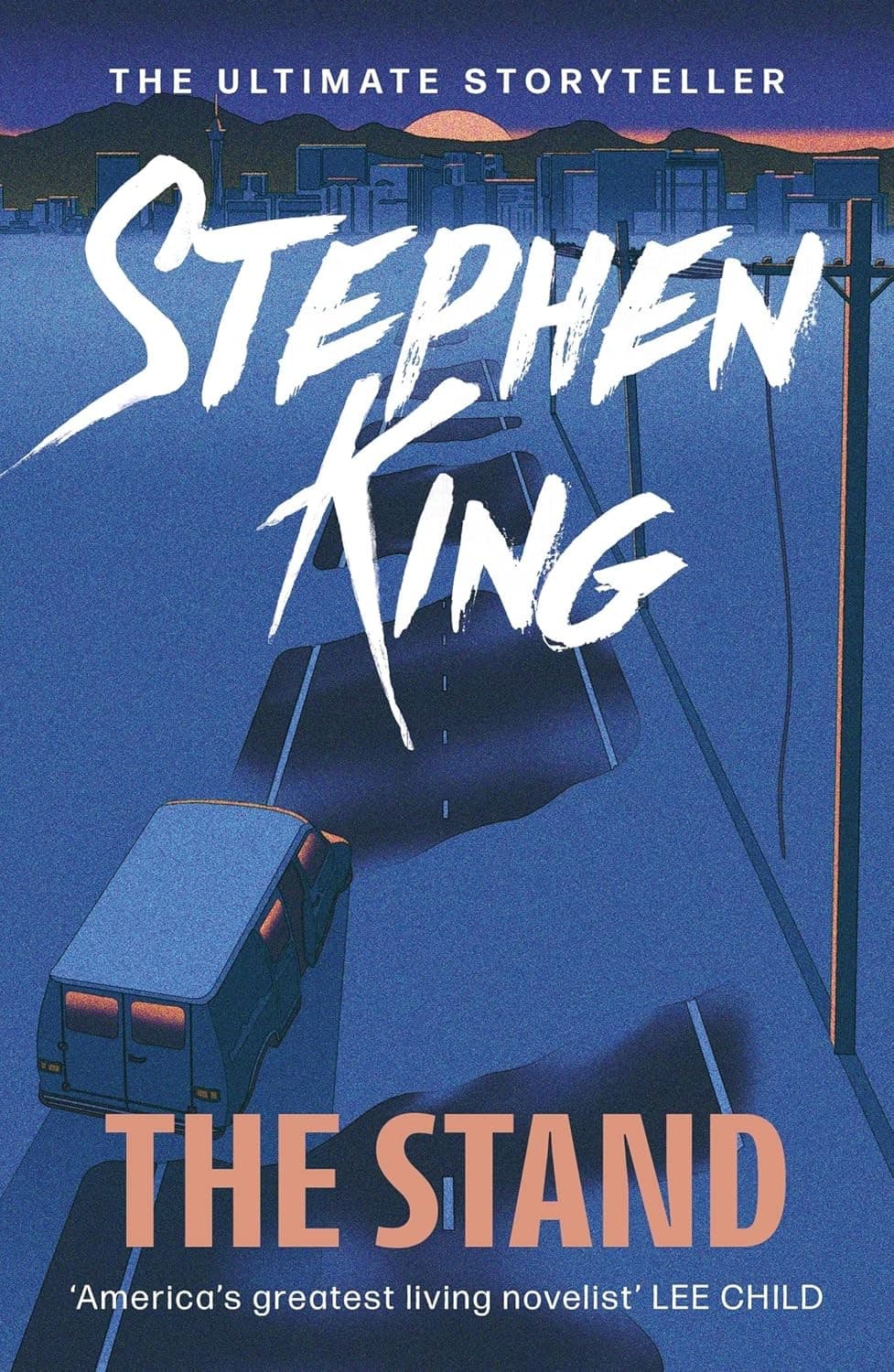
The Plague You Were Promised
A weaponized superflu escapes a government lab, kills 99.4 percent of humanity, and the survivors sort themselves into two camps — one in Boulder, one in Las Vegas — to reenact the oldest story we know. Stephen King wrote this in the mid-1970s, published it in 1978, and expanded it in 1990. He could not have known he was writing the American scripture of pandemic fiction, a text that would be quoted in Facebook posts and CDC comment threads and half-serious group chats every time a novel pathogen crossed a border. And yet here we are, forty-eight years later, and the book reads less like prophecy than like a mirror someone left facing the wrong direction.
What King got right was not the virology. Captain Trips is a cartoonishly lethal pathogen, a 99.4% kill rate that no real-world respiratory virus has approached. What he got right was the sociology. The government lies. The media is slow, then complicit, then dead. People flee, and in fleeing spread the thing they're running from. Neighbors turn on neighbors not because of the disease itself but because of the information vacuum it creates. In 2020, when COVID-19 arrived with a kill rate orders of magnitude lower than Captain Trips, the behavioral patterns King described — the denial, the hoarding, the conspiracy thinking, the frantic search for someone to blame — played out with eerie fidelity. He understood that a plague doesn't just kill bodies; it kills trust. That part he nailed. What he missed entirely was the digital layer. There is no internet in The Stand, no social media, no real-time misinformation ecosystem. The information breakdown in his novel comes from silence — stations going off the air, phones going dead. In our actual pandemic, the breakdown came from noise. Too much information, too fast, too unfiltered. King imagined the apocalypse as a blackout. It turned out to be a feed that wouldn't stop scrolling.
The novel's deeper architecture — the Manichaean split between Mother Abagail's Boulder Free Zone and Randall Flagg's Las Vegas — is both its greatest strength and its most dated feature. King commits fully to the idea that in the aftermath of catastrophe, people will self-sort along moral lines, gravitating toward either democratic community or authoritarian spectacle. In 1978, this read as mythic. In 2026, it reads as a disturbingly literal description of American political geography. The Boulder contingent holds town meetings, debates civil liberties, agonizes over due process. The Vegas contingent offers power, entertainment, and the comfort of not having to think. King meant this as allegory. It now functions as reportage. But the binary is also where the book shows its age. There is no room in King's moral universe for the ambivalent, the disengaged, the algorithmically radicalized. His evil is charismatic and intentional. Ours is diffuse and emergent. Flagg is a figure you can confront. Try confronting a recommendation engine.