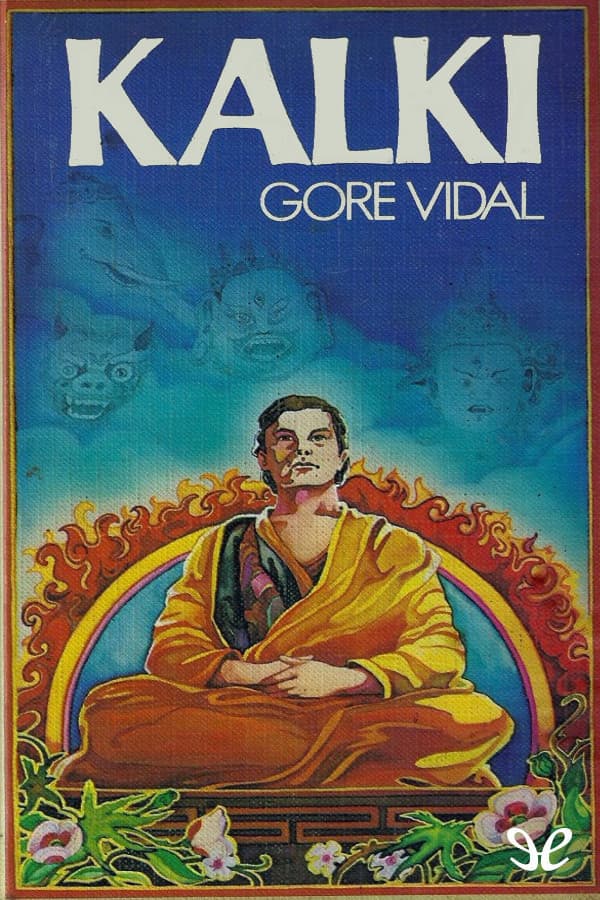
The God Who Went Viral Before Virality
Vidal wrote *Kalki* in 1978 and set it approximately nowhere and everywhere, a near-future that smelled like the late Carter administration but dreamed in Sanskrit. The premise is simple enough to be absurd: a Vietnam veteran named J.J. Kelly declares himself the tenth avatar of Vishnu, builds a media empire around the promise of apocalypse, and then delivers on it. Everyone dies. The lotuses fall. What makes the novel worth returning to in 2026 is not the apocalypse itself — fiction has always loved those — but the machinery Vidal built around it. He understood, with a clarity that embarrasses most of his contemporaries, that the end of the world would be a media event first and a physical one second. Kalki doesn't destroy humanity through divine wrath alone; he does it through television appearances, magazine profiles, Madison Square Garden spectacles, and a public assassination that turns out to be staged. The apocalypse is a product launch. Vidal saw that the line between prophet and influencer was already dissolving in the 1970s, and he simply extended the curve.
The prescience is uneven but, where it lands, it lands hard. The novel's depiction of a charismatic figure weaponizing tax-exempt religious status to launder money and consolidate political power reads less like satire now than like a congressional hearing transcript. The interplay between Kalki's organization and the CIA, the Senate committees circling without ever quite biting, the way media figures treat existential threat as content — all of this has aged into documentary realism. Vidal also anticipated the strange complicity between institutional skepticism and popular credulity: everyone in power knows Kalki is probably a fraud, and nobody can stop the momentum because the spectacle has its own physics. What he could not imagine, and this is the telling absence, is the decentralization of that spectacle. Kalki still needs network television, a yacht, a Garden booking. There is no internet here, no algorithmic amplification, no thousand smaller Kalkis competing in a marketplace of apocalypses. Vidal's world is still one where a single figure can monopolize eschatological attention. That feels quaint now, almost nostalgic.
The novel's blind spots are mostly structural rather than ideological. Teddy Ottinger, the narrator, is Vidal's attempt at a feminist protagonist — a female aviator, bisexual, sharp-tongued, professionally thwarted by men. She is drawn with genuine sympathy and occasional real insight into the texture of institutional misogyny. But she is also, unmistakably, a man's idea of a liberated woman circa 1978: her interiority is dominated by her relationships with men, her body, her attractiveness. Her bisexuality is treated as adventurous rather than ordinary. The novel's handling of India and Hinduism is more complicated. Vidal clearly did his homework, and Dr. Ashok serves as a useful corrective voice against Western appropriation of Hindu theology. But the novel still treats South Asian religion primarily as raw material for an American con, and the Indian characters exist largely to authenticate or debunk Kelly's claims for a Western audience. The post-apocalyptic final act, in which the survivors tour empty Paris and loot the Louvre, has a colonial leisure to it that Vidal may or may not have intended as satire.