The Bells Were Already Ringing
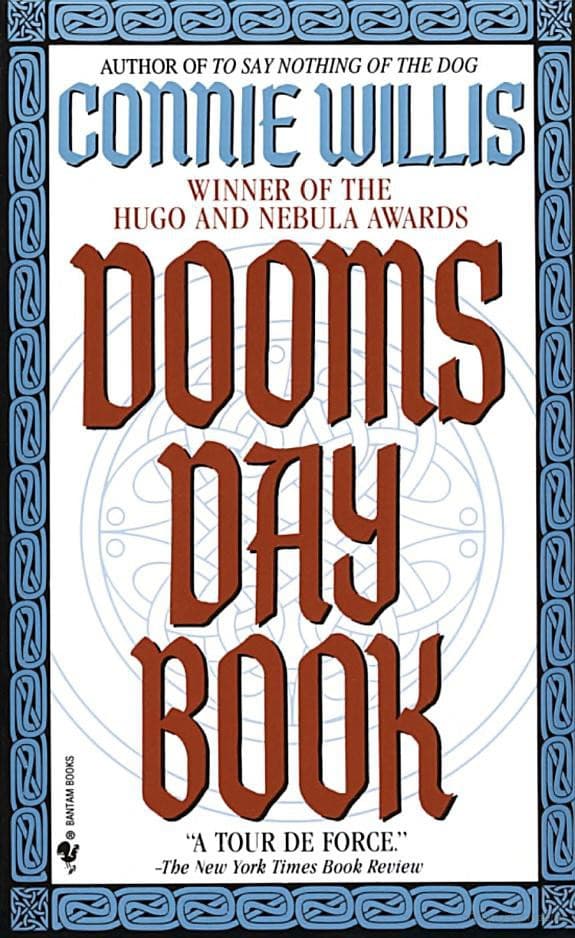
Connie Willis published *Doomsday Book* in 1992, which means she wrote a novel about a pandemic grinding an advanced society to a halt — phones not answered, bureaucracies failing, medical staff collapsing from exhaustion, quarantines imposed with more panic than logic — roughly twenty-eight years before the world watched itself do exactly that. The 2054 Oxford sequences, often dismissed at the time as the weaker half of the novel, now read like a documentary treatment. The influenza epidemic that locks down the city while Dunworthy tries to rescue Kivrin is saturated with details that became viscerally familiar during COVID-19: the shortage of hospital beds, the communication breakdowns between institutions, the way administrative turf wars persist even as people die, the particular horror of watching a system designed for normalcy buckle under exponential pressure. Willis got the emotional texture right — the exhaustion, the guilt, the maddening inability to reach someone on the other end of a line. What she didn't anticipate was social media, which means her quarantine lacks the specific psychosis of real-time misinformation. Her 2054 still runs on phone trees and physical couriers. There are no feeds, no conspiracy theories about the virus being manufactured. The information problem in her future is absence, not noise. That feels almost quaint now, and it marks the book as a product of the early 1990s in ways her medieval research does not.
The 1348 chapters hold up with a solidity that borders on ruthless. Willis's depiction of plague — the buboes, the delirium, the smell, the way a household empties room by room — was already considered harrowing in 1992. It is more harrowing now because we have a closer frame of reference. Not because COVID-19 was the Black Death, but because we now understand in our bodies what it means to watch a disease move through a community faster than anyone can respond to it. The scene where Kivrin lances Rosemund's bubo is almost unbearable, not for its gore but for its futility — the knowledge that care, even desperate and painful care, is not the same as cure. Willis understood something that many pandemic narratives still fumble: the worst part is not the dying but the tending. The people who stay. Father Roche, that stumbling, inarticulate, entirely adequate priest, remains one of the most honest portraits of essential workers in fiction, written decades before we had that term and then promptly forgot what it meant.
The novel's blind spots are instructive. Willis imagined a future Oxford that is still recognizably hierarchical, still governed by dons and committees, still dependent on a single technician who understands the critical system. There is no artificial intelligence managing the net. There is no distributed computing. The time travel apparatus is treated like a particle accelerator — expensive, singular, requiring specialized human operators — rather than anything networked or automated. This is a 1992 imagination of institutional science, and it shows. More subtly, the book assumes that the primary barrier to understanding the past is linguistic and cultural, which is why Kivrin's interpreter implant is the key technology. Willis could not have foreseen the degree to which machine translation and large language models would collapse the distance between languages in our own time, making her 2054's reliance on implanted translators feel both over-engineered and under-imagined. The real barrier, the book ultimately argues, is not language but presence — being there, in the room, with the dying. On that point, no technology has made Willis wrong.