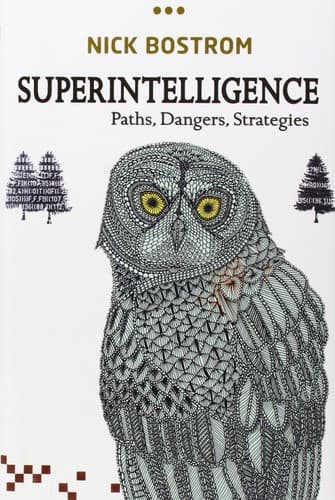
The Owl Arrives Before the Cage Is Built
Bostrom's *Superintelligence* was, in 2014, a book about a problem that didn't exist yet. Twelve years later, it is a book about a problem that half-exists — which turns out to be a more uncomfortable condition than either full absence or full arrival. The sparrows in his opening fable wanted an owl to serve them. What we got instead, between 2022 and 2026, was something more like a very large parrot that occasionally reasons, sometimes hallucinates, and has already reshaped labor markets, electoral information ecosystems, and the internal priorities of every major technology company on Earth. Bostrom anticipated the *gravity* of the problem with eerie precision. What he did not anticipate — could not have, really — was the specific shape of the vessel. He imagined a singular intelligence explosion, a discrete moment of takeoff. What arrived was a diffuse, commercially driven, iteratively deployed series of capability jumps, each one insufficient to qualify as superintelligence but collectively sufficient to make his warnings feel urgent in ways his framework struggles to accommodate. The control problem is real. It just doesn't look like an oracle in a box. It looks like a thousand products shipping with alignment unsolved, because the market won't wait.
His taxonomy of superintelligence types — speed, collective, quality — remains conceptually useful, but the landscape of 2026 has revealed a form he barely sketched: the *ambient* superintelligence, distributed across millions of API calls, fine-tuned instances, and agentic scaffolding, none of which individually qualify as superintelligent but which in aggregate reshape what it means to be a knowledge worker, a student, a voter. His Chapter 11 on multipolar scenarios now reads as the most prescient section of the book, though for reasons he might not have intended. We do not have a singleton. We have OpenAI, Anthropic, Google DeepMind, Meta, and a handful of Chinese labs in a competitive dynamic that rhymes uncomfortably with the arms-race scenarios he warned about, minus the dramatic decisive strategic advantage. The race is real. The finish line keeps moving. Nobody has won, and the absence of a clear winner has not made things safer — it has made coordination harder, exactly as he predicted.
The book's most significant blind spot is its near-total silence on the economics of deployment. Bostrom wrote as though the transition to superintelligence would be a research event — a lab achievement, a threshold crossed. He did not reckon with the possibility that extremely capable but sub-superintelligent systems would be released as consumer products, that alignment failures would manifest not as treacherous turns but as mundane harms at scale: misinformation generated fluently, jobs automated without social infrastructure to absorb displaced workers, surveillance capabilities handed to states that had no intention of building Bostrom's careful governance frameworks. He also underestimated biology's stubbornness — whole brain emulation remains distant, and the biological cognition enhancement path has not materialized in any meaningful way. The path that mattered was the one he spent the least philosophical energy on: brute-force scaling of transformer architectures on internet-scale data. The owl, it turns out, was trained on our garbage.