The Fat One, the Thin One, and the Question of Who Gets to Be Real
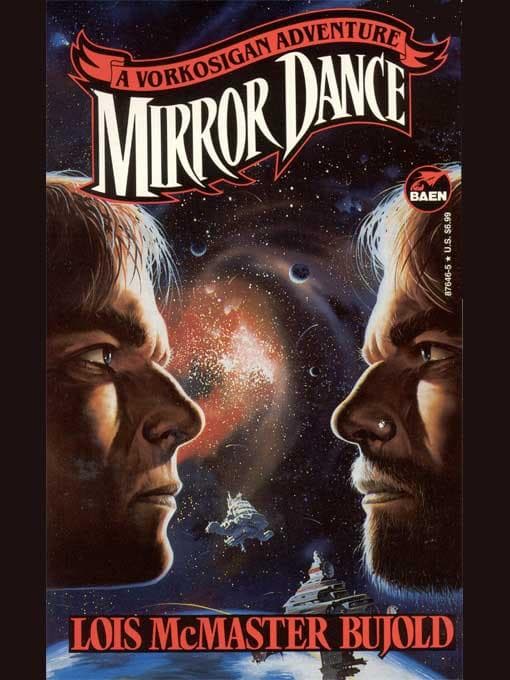
Thirty-two years on, *Mirror Dance* reads less like space opera and more like a clinical study of what happens when identity becomes a commodity — when a person can be grown to spec, discarded, and replaced, and the only thing preventing this from being ordinary is the inconvenient persistence of consciousness. Bujold published this in 1994, the year the first mammalian cloning experiments were generating headlines, and she was already past the biological question. She didn't care whether you *could* clone a person. She wanted to know what you owed that person afterward. In 2026, with synthetic embryo research pushing past fourteen-day limits, with AI-generated likenesses raising questions about consent and selfhood, with organ-on-chip technology inching toward the transplant economy Bujold imagined on Jackson's Whole — the novel's central horror is no longer hypothetical. The Bharaputran clone trade, where children are grown as brain-transplant vessels for the wealthy, maps uncomfortably well onto current anxieties about bodies as products. What Bujold got wrong, or rather what she couldn't have foreseen, is that the identity crisis wouldn't require biological cloning at all. Digital doubles, deepfakes, and large language models have accomplished a version of Mark's predicament — the uncanny experience of encountering something that wears your face and speaks in your patterns but isn't you — without growing a single cell.
The novel's treatment of dissociative identity as survival strategy is where the years have been kindest to it. Mark's fragmentation into Gorge, Grunt, Howl, and the unnamed fourth is not played for horror or spectacle. It is presented as engineering — the mind building load-bearing walls to keep the house standing under torture. In 1994 this was bold but somewhat exotic territory for genre fiction. In 2026, after decades of increasingly public conversation about trauma responses, after the language of parts-based therapy models like Internal Family Systems has entered mainstream discourse, Mark's "black gang" reads almost like a textbook illustration rendered in narrative form. Bujold wasn't writing a clinical manual, but she understood something that took popular culture another twenty years to absorb: that multiplicity can be functional, that the fractured self is not necessarily the broken self. The scene where Ryoval realizes he hasn't been torturing one person but several, and that this has been his undoing, remains one of the most quietly devastating reversals in the Vorkosigan saga.