The Hum of Alien Protocols
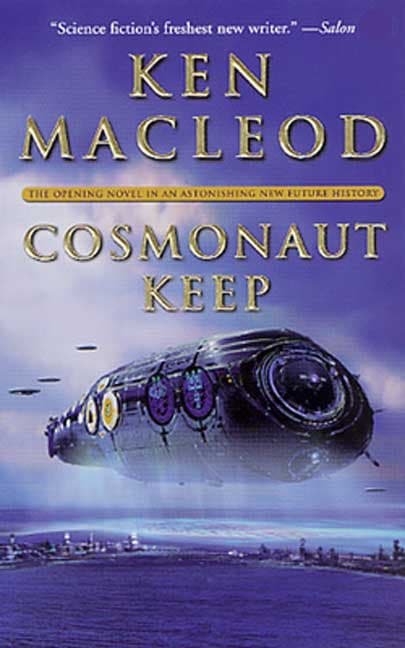
Ken MacLeod wrote *Cosmonaut Keep* in the last months before September 2001 reshaped the political imagination of Anglophone science fiction, and you can feel the book breathing air from a world that still believed the interesting questions were about information, not security. The novel's dual timeline — one strand set in a near-future Edinburgh of leftist hackers and EU-adjacent political intrigue, the other on a distant human colony world where interstellar travel depends on alien gatekeepers — is held together by a single obsession: who controls the channel, and what they choose to share. In 2001, this was a novel about SETI and socialism. In 2026, it reads as a novel about platform dependency and the politics of API access. MacLeod's aliens don't invade; they curate. They selectively release data. They maintain navigational monopolies that keep human civilizations functional but subordinate. Replace "alien navigators" with "foundation model providers" and the political topology is uncomfortably familiar. The humans in the Second Sphere aren't oppressed. They're downstream.
MacLeod anticipated, with considerable precision, the way technological dependency can masquerade as partnership. His colonial worlds don't lack capability — they lack the root knowledge that would let them operate independently. Gregor's induction into the project of reverse-engineering alien navigation is not a heist plot; it's an infrastructure sovereignty argument dressed in space opera clothes. This maps neatly onto 2020s debates about semiconductor supply chains, sovereign cloud computing, and the way small nations negotiate with technological superpowers who offer services too convenient to refuse. The novel also gets something right about the texture of hacker culture — the mixture of ideological commitment and sheer curiosity, the way political radicalism and systems thinking feed each other. MacLeod's Edinburgh feels less dated than it should, partly because the city itself has continued to produce that specific breed of technically literate, politically restless Scot.
What the book misses is revealing. There is no social media. There is no attention economy. The information politics in the near-future strand are still fundamentally about access to secrets rather than drowning in noise. MacLeod imagined a world where the problem was that someone was hoarding signal; we got a world where signal is buried under an ocean of procedurally generated sludge. The alien interface — described as vast, multifaceted, overwhelming — was meant to evoke the sublime. Now it reads like a description of trying to parse a large language model's latent space. The saurs, MacLeod's reptilian co-inhabitants of human worlds, are drawn with genuine affection for the problem of interspecies diplomacy, but they remain legible as cultural Others in a way that assumes good-faith negotiation is the default mode of contact. Twenty-five years of platform capitalism have made that assumption look generous.