The Eschaton Wears Sweatpants
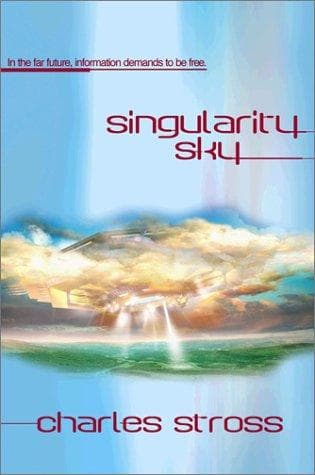
Singularity Sky arrived in 2003 with the swagger of a book that had read all the right papers. Stross, then still sharpening his reputation as the genre's most technically literate provocateur, built a novel around a premise that seemed almost parodic at the time: a godlike superintelligence — the Eschaton — had scattered humanity across the stars, left behind a single commandment ("Thou shalt not violate causality"), and then mostly retreated to let people get on with being people. The joke, of course, was that the people in question immediately set about building repressive aristocratic regimes, suppressing technology, and stumbling into exactly the kind of catastrophic stupidity the Eschaton had warned against. Twenty-three years later, the joke lands harder. We have not built a superintelligence that dispersed humanity, but we have built systems powerful enough to reshape economies and epistemologies overnight, and the dominant institutional response has been a mixture of denial, control, and the kind of bureaucratic panic Stross captures so well in his New Republic admiralty. The Festival — an alien swarm that arrives on a backwater planet and offers advanced technology in exchange for stories, for *entertainment*, for information — now reads less like a thought experiment and more like a parable about what happens when a closed society encounters an open network. Replace "the Festival" with "the internet arriving in a country that banned it" and you have something uncomfortably close to recent history. The citizens of Rochard's World don't know what to do with cornucopia machines. Neither, it turns out, did we.
What Stross got right, with eerie specificity, was the political economy of sudden technological abundance. The Festival doesn't invade. It offers. It gives people whatever they ask for, and the result is not utopia but a cascading series of destabilizations — economic, social, psychological — that the existing power structure is wholly unequipped to manage. The New Republic's response is to send a fleet. This is the logic of every government that has tried to solve an information problem with a military one, from the Great Firewall to content moderation by blunt force. Stross understood, before most of his contemporaries, that the real danger of a technological singularity is not that machines become hostile but that institutions become irrelevant faster than they can adapt. The Eschaton itself is almost boring — a background constraint, a regulatory body operating at cosmological scale. The drama is entirely human: people making terrible decisions with incomplete information, under pressure, while a system they cannot comprehend reshapes the ground beneath them. In 2003, this was speculative. In 2026, after watching generative AI tools arrive like the Festival's cornucopia machines — offering everything, demanding only data — it reads like a case study written slightly too early.