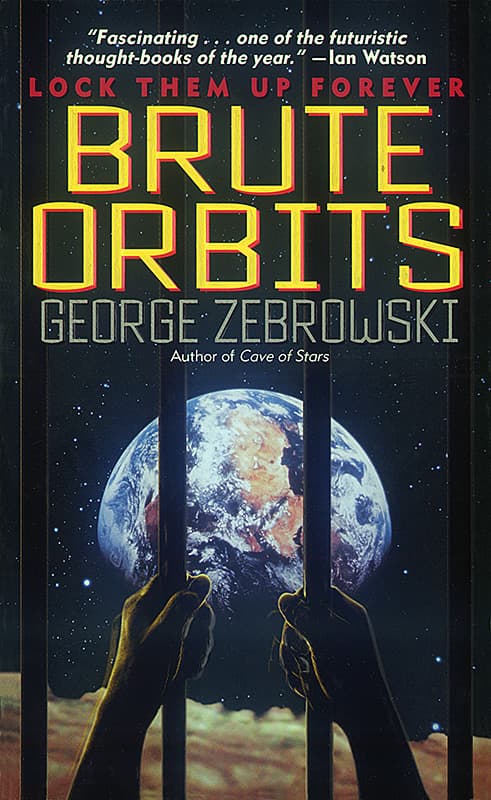
The Gravity of Disposal
George Zebrowski's *Brute Orbits* is a book about what happens when a society decides that certain people are not worth keeping close. Mined-out asteroids become prisons. Convicts are loaded into hollowed rock and shoved into long cometary orbits — years, decades, centuries from return. No parole. No appeal. Just the slow arithmetic of celestial mechanics ensuring that the discarded stay discarded. In 1998, this read as a thought experiment in punitive excess. In 2026, it reads like a procurement proposal someone forgot to redact.
The prescience is uncomfortable in its specifics. Not the asteroids — we're not there yet, though the private space-mining industry has moved from joke to SEC filing in the intervening decades. What Zebrowski nailed is the political logic. The quiet bipartisan consensus that certain populations can be warehoused out of sight, that the architecture of punishment can be scaled up precisely because no one wants to look at it. The United States in 2026 incarcerates at rates that would have seemed dystopian in most prior centuries, and the political conversation around immigration detention, offshore processing, and the use of remote facilities tracks Zebrowski's core insight almost exactly: distance is policy. The further you put the problem, the less it is a problem. His "brute orbits" are an engineering solution to a moral question, and we have spent the last twenty-eight years proving that such solutions are not speculative fiction but standard operating procedure. The subplot involving Abebe Chou — a political prisoner exiled by elites hoarding "longlife privilege" — now resonates with the global discourse around longevity therapeutics, where access to rapamycin analogs and GLP-1 receptor agonists is already stratifying along class lines, even if no one is being launched into the Oort Cloud for pointing it out. Yet.
Where the book shows its age is in its faith that the public would eventually care. Zebrowski imagines prison breaks, public outcry, moral reckonings — the machinery of democratic conscience grinding slowly but grinding. This feels generous now. The dominant pattern of the 2020s has been the normalization of the extraordinary: surveillance regimes, indefinite detention, algorithmic sentencing, the quiet expansion of carceral infrastructure into digital and geographic spaces that most citizens never see and therefore never protest. Zebrowski assumed a threshold of visible cruelty beyond which societies would rebel. We have learned that the threshold moves. It always moves. His blind spot is not technological but psychological — he underestimated the human capacity for motivated ignorance when the architecture of punishment is designed to be boring. He also couldn't quite see the role that data and algorithmic systems would play in sorting who gets exiled and who doesn't; his elites are recognizably human conspirators, not opaque recommendation engines.