The Duel as Political Philosophy
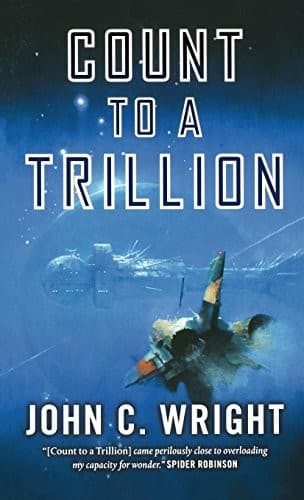
Menelaus Montrose solves two problems in this book with the same method: he shoots something until it stops being a problem. The first time it's Mike Nails, over a legal dispute in a collapsed Texas where pistols still settle contracts. The second time it's his own cerebral cortex — he empties a syringe of alien-derived neurochemistry into himself mid-expedition, against protocol, because committee deliberation over the Promethean Formula was taking too long. Wright treats both acts as the same gesture: a man refusing to wait for permission from an institution he doesn't trust. That's the load-bearing idea of the whole fifteen-year-old doorstop, and it's worth sitting with now that we've actually watched an intelligence explosion arrive — not as self-administered genius serum but as server farms, RLHF pipelines, and quarterly earnings calls. Wright bet the augmentation story on an individual frontier hero defying a council. History gave us a council that became the hero, diffuse and incorporated, with no Menelaus to duel.
The Monument itself is the better anticipation. Once Montrose and Del Azarchel get deep enough into translating it, the alien hierarchy reveals itself not as malevolent but as actuarial: the Hyades Domination doesn't hate humanity, it has simply run the equations and found humans worth enslaving at a specific, calculable discount rate — "the degree of control," "hierarchical cascade functions," a whole cosmos of dominant and client species negotiating what the text calls, without irony, the Cold Equations. Humanity's debt to its conquerors is structured as indentured servitude with a manumission clause, because the math shows cooperation is marginally cheaper than extermination. This is Bostrom's instrumental-convergence argument — the paperclip maximizer that doesn't hate you, it just has other uses for your atoms — arrived at three years before *Superintelligence* gave the thesis its academic furniture, and arrived at through pulp cosmology rather than decision theory. The novel's own caste vocabulary for this, borrowed straight from Gnosticism — Hylics, Psychoi — sits uncomfortably close to the language a certain strain of tech commentary now uses for itself in earnest, sorting the world into those who can "decouple" and those who can't. Wright doesn't seem to be satirizing that impulse. He seems to share it.
What doesn't survive the trip to 2026 is the social scaffolding Wright hangs all this on. The honor-duel code, the morganatic marriage, the hereditary Hermeticist aristocracy ruling by sheer IQ — these aren't background texture, they're the novel's actual utopia, the "better world" Del Azarchel promises Montrose on his first morning awake centuries later. A book this suspicious of centralized government keeps arriving, by the most direct possible route, at monarchy — just monarchy credentialed by neural augmentation instead of blood, which it apparently finds more legitimate. That tension between frontier libertarian individualism and an aristocracy of cognition never resolves; it just keeps restaging itself as a gunfight. I've made a version of this argument before about Brin's uplift hierarchies, where intelligence is a debt owed to a patron — Wright's version is almost the inverse, intelligence as something stolen, Promethean, and the theft is treated as the noble act rather than the original sin that needs accounting for.