The Human Cargo Has No Vote
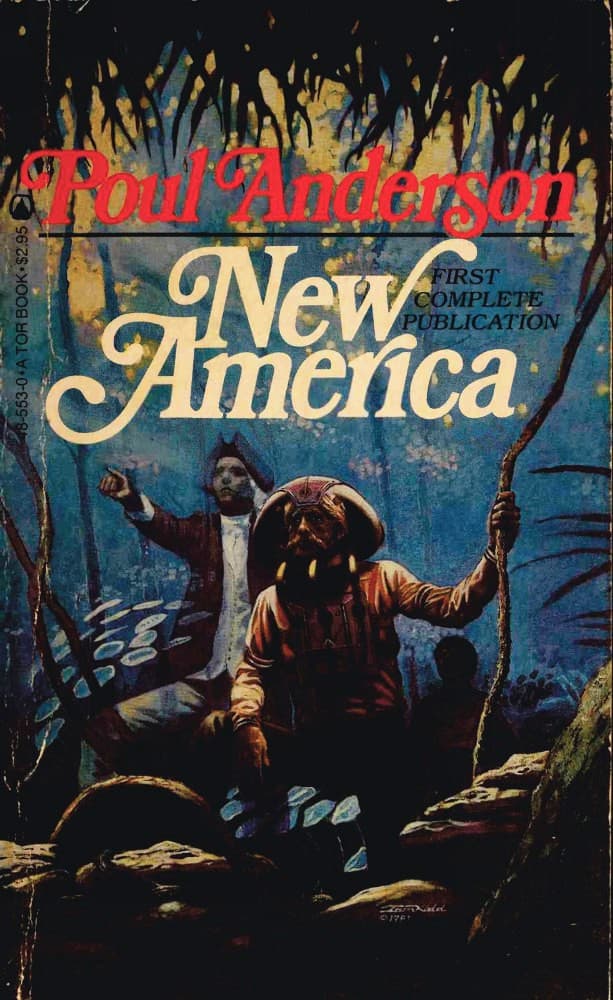
Open the front matter and the seams show immediately: this is not one novel but three novellas — set on three different worlds, Rustum, Roland, Mithras — welded together by a preamble about Jeffersonian exiles and retrofitted into a single continuous mythology, with a Hugo-winning novelette thrown in as bonus material and two appendices on relativistic physics bolted to the end like a shop manual. Anderson built an American diaspora out of stories that were never written to be one. The device is less dishonest than it sounds. It mimics, almost accidentally, the way founding myths actually get made — after the fact, out of unrelated material, stitched smooth enough that nobody asks where the thread shows.
The thread shows most at the Constitutional Convention on Rustum, where the colony debates whether to admit a fleet of refugees from an Earth gone totalitarian. Anderson gives the restrictionist case, through Dr. O'Malley, real intelligence and real applause: "they are a potential poverty class," "we are not immune to the ancient diseases of xenophobia, callousness, legalized robbery, and mob violence," "the point is, they are alien." Coffin's rebuttal — fling the gates open, dilute the gene pool, "God damn it, that's exactly what we need" — gets the narrative's sympathy but not the room's. Read in 1982 this was an abstraction about a hypothetical starship. Read now it is nearly a transcript: the vocabulary of assimilation, burden, and cultural dilution hasn't shifted so much as migrated media. Anderson didn't predict immigration politics. He just wrote down an argument old enough that forty-four years barely dented its phrasing.
What the convention never does — cannot do, structurally — is let the fleet answer back. The immigrants are cryogenic cargo, seventy years from reply, discussed entirely in the conditional by people deciding their fate in a room they will never enter. That absence is the actual subject, more than either side of the debate: a founding document is being drafted about a population that has no vote in its drafting, on a planet whose own preamble describes Earth's enemy government as "orientalized" without apparent irony, three chapters before a different colony agonizes, sincerely, over its obligations to the native Mithrans it has no intention of leaving. The book is capable of anti-colonial scruple toward aliens and entirely incapable of it toward its own founding gesture. That contradiction isn't a flaw Anderson somehow missed; it's the actual shape of the Jeffersonian project, rendered with more honesty than the author probably intended.