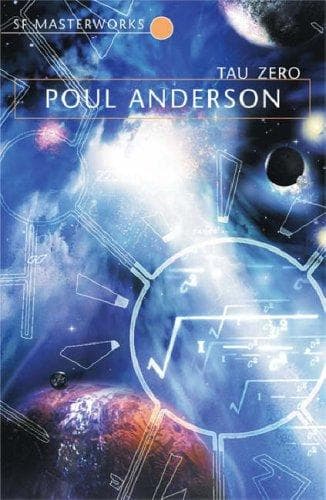
The Ship That Outran Everything Except 1970
Poul Anderson wrote a novel about a starship that cannot stop accelerating and so passes through the death and rebirth of the universe, and yet the most dated thing in it is the gender politics at the crew's farewell party. Tau Zero remains one of the purest expressions of hard science fiction's central wager: that if you get the physics right, the human story will take care of itself. Anderson largely wins that bet on the physics. The Bussard ramjet, the tau factor's exponential compression of time, the relativistic distortion of starlight — these hold up with startling fidelity against fifty-six years of subsequent astrophysics. What he could not have known is that the cosmology he extrapolated — an oscillating universe that collapses and rebounds — would be effectively ruled out by the 1998 discovery of accelerating expansion. The novel's climax, in which the crew surfs the monobloc of a new Big Bang, depends on a universe that does not exist. This does not ruin the book. It does change what the book is about. It was meant as a plausible extrapolation. Now it reads as myth.
Anderson anticipated several things with quiet accuracy: the psychological toll of radical isolation, the way small communities under extreme stress fracture along lines of sexual jealousy and authority rather than ideology, the necessity of a figure like Reymont — part enforcer, part therapist, part tyrant — to hold a fragile social organism together. In 2026, after years of analog Mars mission studies, Antarctic winter-over research, and the ongoing soap opera of the International Space Station's crew dynamics, his portrait of shipboard psychology feels less speculative and more like a field report. The dream boxes that crew members become psychologically dependent on read now as an uncanny prefiguration of immersive digital escapism, from VR headsets to the scroll-hole of algorithmic feeds. Anderson saw that the technology of comfort could become the technology of withdrawal. He did not see smartphones, but he saw the problem smartphones would create.
The blind spots are loud. Ingrid Lindgren is the most competent woman on the ship and she is defined almost entirely by her relationships with men — who she sleeps with, who she refuses, whose emotional collapse she manages. The novel's final chapter, in which Reymont calmly explains that the surviving women will need to bear children by multiple fathers for genetic diversity, reads in 2026 less like pragmatic biology and more like a particular male fantasy of the post-apocalypse dressed in the language of species survival. Anderson was not a crude writer, but he was a writer of his moment, and his moment assumed that competent women would ultimately defer to decisive men. The crew of fifty includes representatives of various nations — a careful Cold War internationalism — but their cultural differences dissolve almost immediately into a generically Western social dynamic. The Swedish setting and European flavor are window dressing on an American story about frontier resilience.