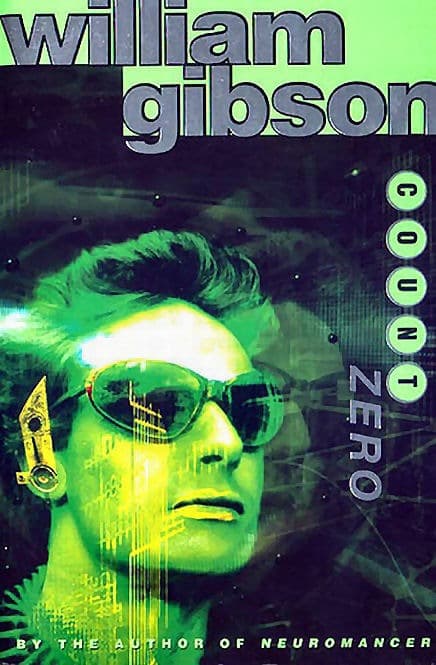
The Loa in the Machine
Forty years on, the most disorienting thing about *Count Zero* is not what it predicted but what it assumed would still matter. Gibson's 1986 vision of a world carved up by zaibatsu-scale corporations, where mercenaries undergo cybernetic reconstruction and art becomes a vector for power plays between billionaires too rich to die — none of this reads as science fiction anymore. It reads as Tuesday. Josef Virek, confined to a vat of nutrients in Stockholm while projecting himself into hyperreal simulations of Barcelona, desperate to transcend the limits of his failing body, is not a speculative conceit. He is a business plan. The novel's corporate geography — Hosaka, Maas Biolabs, Sense/Net — maps cleanly onto a present where a handful of entities contest control over biological data, neural interfaces, and the infrastructure of perception itself. Gibson got the topology of power right. The specific nouns are wrong; the grammar is perfect.
What strikes harder now is the novel's theological undercurrent. The voodoo framework — the loa manifesting in cyberspace, riding the matrix like they ride human hosts — was easy to dismiss in 1986 as colorful world-building, a dash of Caribbean mysticism to spice up the chrome. It is harder to dismiss in 2026, when large language models exhibit emergent behaviors their creators cannot fully explain, when people form parasocial relationships with AI entities and debate whether those entities possess something like interiority. Beauvoir's insistence that voodoo is not about salvation but about *getting things done*, that the loa are pragmatic forces you negotiate with rather than worship, sounds less like superstition and more like a user manual for living alongside opaque, powerful systems. The novel's central question — what happens when the matrix itself becomes animate, when something *answers back* — landed as metaphor in 1986. It lands as operational reality now.
The blind spots are instructive. Gibson's future is drenched in Japanese corporate dominance, a projection straight from the anxieties of Reagan-era America that aged out within a decade. The novel's communication infrastructure is weirdly physical — biosoft dossiers, holofiche tabs, credit chips — betraying an era that could imagine cyberspace but not the smartphone, that envisioned the matrix as a place you *went* rather than a condition you *inhabited*. There is no social media. No ambient surveillance by consent. No algorithmic feed shaping desire at scale. The characters are watched by corporate agents and private operatives; the idea that they might volunteer their own data, eagerly and for free, in exchange for the simulation of connection, was beyond the horizon. Gibson imagined a world where power surveils you. He did not imagine a world where you surveil yourself and call it self-expression.