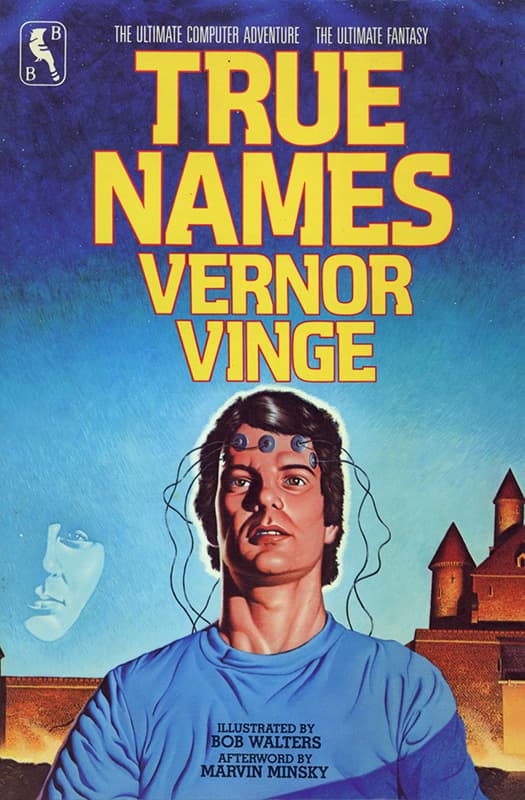
The God in the Phone Lines Knew Your Name Before You Did
Vernor Vinge wrote *True Names* in 1981, published it as a novella, and by 1984 it had its own illustrated edition with a Marvin Minsky afterword bolted on like a philosophical caboose. This was three years before William Gibson's *Neuromancer* would crystallize the word "cyberspace" into the popular lexicon. Vinge got there first, and he got there differently. Where Gibson would give us noir rain and corporate zaibatsus, Vinge gave us something stranger: a virtual realm rendered not as chrome geometry but as sword-and-sorcery landscape, a deliberate metaphor for the way human brains translate abstraction into narrative. The Other World isn't a design choice by some future interface team. It's what happens when you jack a mammalian cortex into pure information and the cortex does what it always does — it tells itself a story. In 2026, after two decades of watching people build avatars, inhabit MMOs, and now argue about spatial computing and AI-generated environments, this reads less like speculation and more like a neurological thesis that the industry is still catching up to.
The prescience is real but unevenly distributed. Vinge nailed the centrality of identity — the concept of the True Name, the idea that your power in the digital realm is proportional to your anonymity, and that the most dangerous thing anyone can do to you is connect your handle to your birth certificate. This is doxxing, described a decade before the web existed. The government's leverage over Roger Pollack is precisely the leverage that states now exercise over hackers, leakers, and pseudonymous dissidents: we know who you are, so you will cooperate. The Mailman, an entity of unclear origin pursuing ideological or perhaps post-human goals through network manipulation, reads uncomfortably like a 2026 headline about autonomous AI agents or state-sponsored influence operations — something that isn't quite a person but acts with a person's intentionality, or exceeds it. Vinge even gestured toward the Singularity here, years before he'd formalize the concept in his famous 1993 essay. The climactic expansion of consciousness, where networked minds become something categorically more than human, is the emotional and philosophical core of the story. He meant it. He still means it.
What Vinge couldn't see — or chose not to render — is the banality. His Other World is populated by a small coven of brilliant, eccentric hackers who are essentially an elite. The internet he imagined is a place of power for the skilled few. He did not imagine that the network's most transformative property would be its accessibility to billions of ordinary users, most of whom would use it to argue about politics, share photographs of food, and watch short videos of strangers dancing. The absence of commerce is striking. There is no economy in the Other World, no advertising, no platform capitalism, no attention marketplace. The government is the antagonist, which felt right in 1984 and feels incomplete in 2026, when the more pressing question is what happens when the Mailman is not a rogue AI but a publicly traded company. Vinge's hackers are also conspicuously American, conspicuously individual, and operate in a geopolitical vacuum. The network has no Great Firewall, no Balkanization, no content moderation debates. It is a single, unified space. That dream died sometime around 2012.