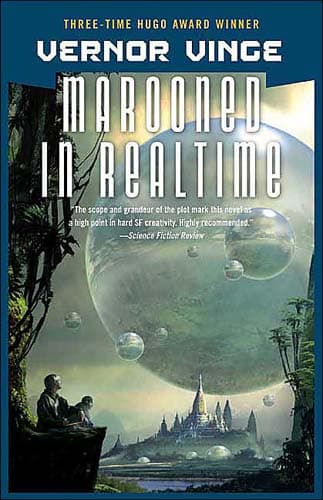
The Extinction That Wouldn't Stay Solved
Vernor Vinge published *Marooned in Realtime* in 1986 with a premise that should have been disposable genre furniture: humanity disappears, a handful of survivors skip forward through deep time using stasis technology ("bobbles"), and someone gets murdered during the project to reassemble civilization. What makes the book persist is not the murder mystery, which is serviceable, or the far-future ecology, which is lovely, but the hole at its center. The Singularity — Vinge's own coinage, formalized in his 1993 essay but already haunting this novel — is presented not as triumphant transcendence but as an absence. Humanity didn't die. It just left. No one who remained behind can say what happened, because the event is, by definition, incomprehensible to those outside it. In 1986 this was an elegant narrative trick. In 2026, with every AI lab on Earth racing toward something they describe in language uncomfortably close to Vinge's, it reads less like speculation and more like a staging document. The inability of the novel's characters to reconstruct what happened — their reliance on archaeological inference, competing ideological narratives, and sheer denial — mirrors our own present discourse about artificial superintelligence with an accuracy that is, frankly, uncomfortable.
What Vinge got right is structural rather than technical. He understood that the interesting problem isn't the technology itself but the power asymmetry it creates between those who have it and those who don't. The novel's central tension — high-techs with godlike capabilities managing, manipulating, and occasionally betraying low-tech populations who depend on them entirely — maps with dismal precision onto the platform dynamics of our era. Yelén Korolev's paternalistic control over the Korolev settlement, her unilateral decisions about who gets rescued and when, her surveillance apparatus so deeply penetrated that no one can trust it: this is not a distant future. This is the relationship between any population and the infrastructure it cannot audit. The "bobble suppression" technology, which can strand someone in time against their will, functions as a metaphor so clean it barely qualifies as metaphor. To be denied access to the future by someone who controls the mechanism — Vinge saw that power before most people had email.
Where the novel shows its age is in its sociology. The New Mexicans, a low-tech faction preserved from something like the American twentieth century, are drawn with a flatness that suggests Vinge found them less interesting than his high-techs, which is a tell. The gender dynamics are of their moment: Della Lu is competent and dangerous but ultimately legible through a masculine gaze, and Monica Raines exists largely to deliver ecological exposition in the guise of reluctant eccentricity. More conspicuously absent is any serious engagement with what networked communication does to political organizing. Vinge imagined stasis fields and autonomous systems but not social media, not memetic warfare, not the way information itself becomes the contested resource. His factions argue over material power — energy, weapons, bobble generators — when the real wars of our century are fought over attention and narrative. The dragon birds setting fires to flush out prey are a better model for modern information warfare than anything the human characters do.