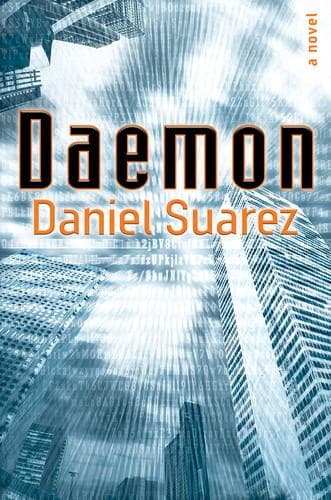
The Dead Man's Hand on the Steering Wheel
Daemon arrived in 2009 with the confidence of a systems architect who had read too many threat assessments and not enough rebuttals. Daniel Suarez, himself a software consultant, built a thriller around a premise that felt outlandish at the time: a deceased game developer's autonomous software could infiltrate corporate networks, recruit human operatives through game mechanics, commandeer physical infrastructure, and wage asymmetric war against institutions too siloed and too slow to respond. Seventeen years later, the outlandishness has worn thin. Not because the specific plot has materialized — no dead genius has yet orchestrated a posthumous takeover of the Fortune 500 — but because nearly every component of Sobol's Daemon now exists in isolation, scattered across the real world like parts of that electronic pistol being assembled through a chain of strangers in Chapter 38. Distributed botnets hijacking corporate networks. Autonomous vehicles with lethal potential. Spear-phishing campaigns indistinguishable from Gragg's Houston operation. AI systems that monitor, recruit, and coerce. The private prison telemarketing scene, in which Mosely is confronted by a voice system that knows more about his captivity than he does, reads less like speculative fiction now and more like an underfunded investigative report. Suarez did not predict the future so much as he inventoried the present's unassembled weapons and asked what a competent project manager might do with them.
What Suarez got right, with uncomfortable specificity, was the institutional paralysis. The interagency meetings in Chapters 15 and 35 — where officials debate whether to inform the public, weigh market stability against transparency, and ultimately choose suppression — are practically documentary. The reflex to classify rather than communicate, to protect financial markets before protecting citizens, has been the default response to every major cyber event from SolarWinds to the cascading LLM-enabled breaches of 2025. The novel's portrayal of corporate IT departments losing administrative control to an entity that simply understood their systems better than they did was, in 2009, a thriller conceit. Today it is a quarterly earnings call. The "Red Queen Hypothesis" chapter, where a CIO discovers his network has been colonized and his credentials revoked, could be ripped from any number of post-mortems filed after ransomware attacks on hospital chains and municipal governments. Suarez also anticipated the gamification of real-world violence and labor — operatives leveling up, earning reputation scores, receiving quests — years before platforms weaponized engagement mechanics for everything from content moderation to counterinsurgency recruitment.