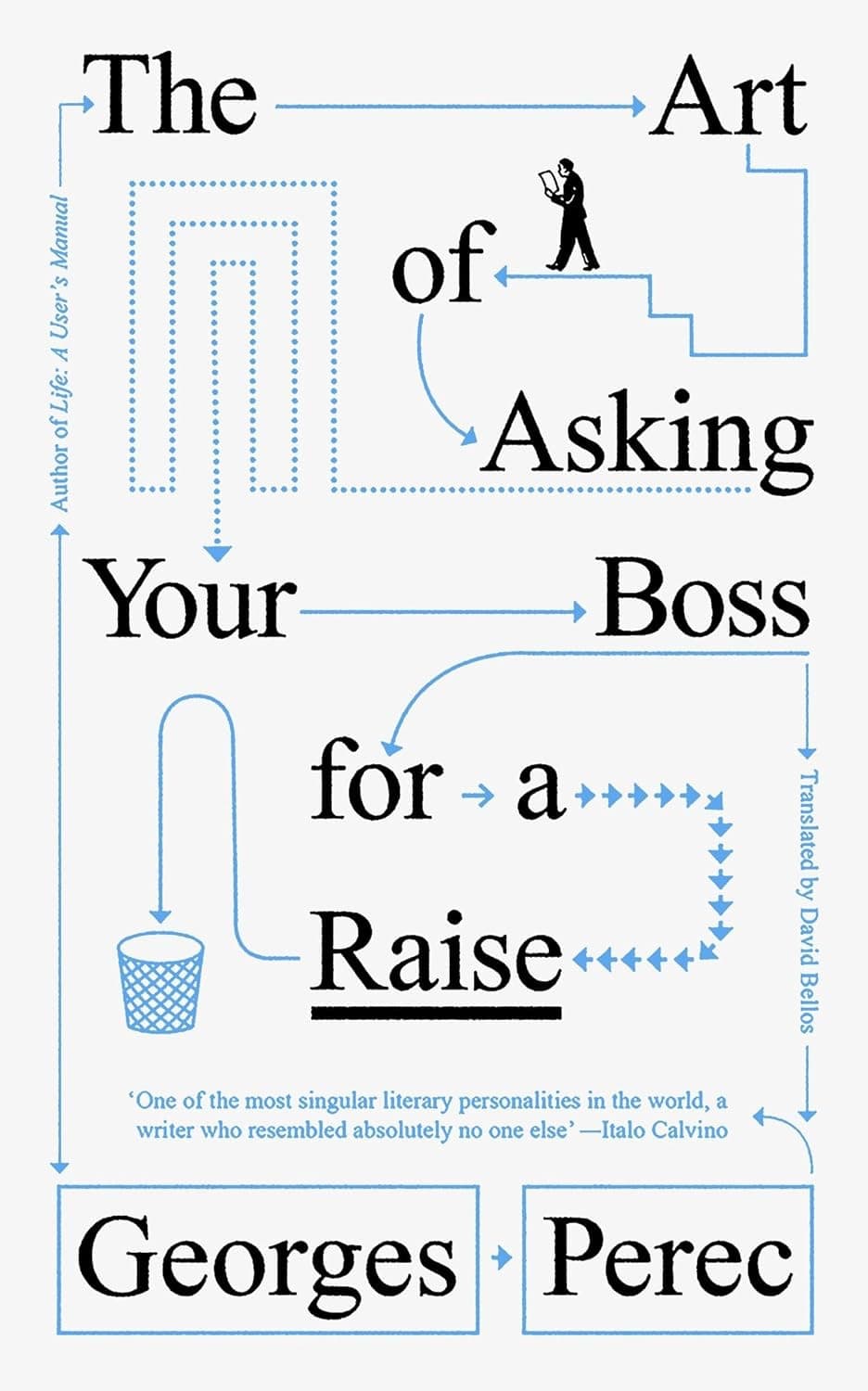
The Flowchart That Ate the Office
Perec wrote this in 1968, not 2008. That matters. The English translation arrived four decades after the original French, which means the book entered Anglophone consciousness at the precise moment its subject was undergoing a terminal mutation. By 2008, the office — the physical, hierarchical, fluorescent-lit office where one circumperambulates departments waiting for Mr. X to return from lunch — was already dying. What Perec had rendered as absurdist comedy in the late sixties had become, by the time David Bellos delivered it into English, something closer to an archaeological document. Now, in 2026, with hybrid schedules, Slack threads replacing hallway encounters, and salary negotiation increasingly mediated by algorithmic compensation bands and AI-assisted HR platforms, the book reads as neither comedy nor artifact but as prophecy inverted. Perec modeled human behavior as an algorithm to expose the absurdity of reducing people to procedural logic. We went ahead and did it anyway, sincerely, at scale.
The formal conceit — a single unpunctuated sentence that loops and branches like a computer program — was Perec's Oulipo experiment in making literature from constraint. He took a flowchart, the kind a systems analyst might draft for IBM, and fed human desperation through it. The result is a text that performs bureaucratic recursion on the body of the reader. You feel the waiting. You feel the pacing. You feel the absurd contingency of whether Ms. Wye is in a good mood, whether the corridor is empty, whether the moment is right. In 2008 this was a curiosity, a charming relic of constrained writing. In 2026 it is uncomfortably literal. Anyone who has tried to schedule a meeting with a skip-level manager through three layers of calendar software, only to be rerouted by an out-of-office auto-reply into a holding pattern of follow-up emails, has lived inside this text without knowing it. Perec didn't predict the specific technologies. He predicted the emotional topology.
What he could not have imagined — what constitutes the book's most telling blind spot — is the disappearance of the boss as a physical presence to be petitioned. Mr. X, in Perec's construction, is a body in a room. The entire comedy depends on spatial proximity: you can see his door, you can hear him on the phone, you can gauge his mood from the set of his shoulders. The contemporary equivalent is a Zoom tile that may or may not be a frozen frame, a green status dot that means nothing, a compensation review conducted by a committee you will never meet, benchmarked against market data you cannot access. Perec assumed the raise was a human transaction, however degraded by hierarchy. The degradation has since been automated. The flowchart won.