The Machine That Runs on Belief
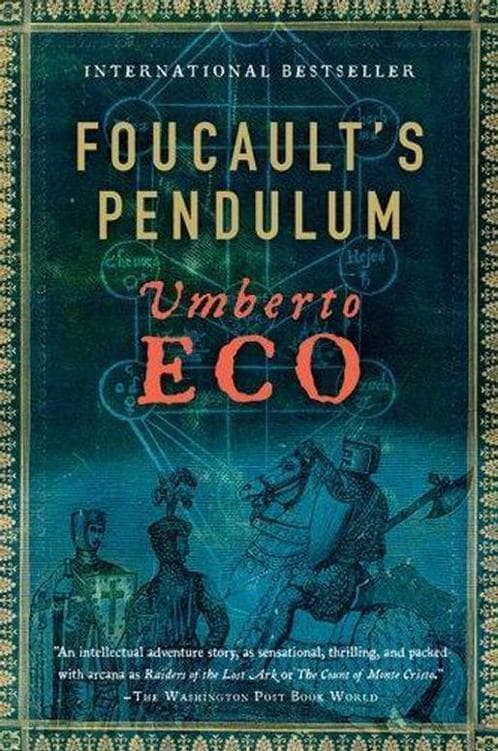
Umberto Eco wrote a novel about three bored intellectuals who invent a conspiracy theory as a joke, feed it enough data to make it cohere, and then watch in horror as the world decides it's real. He published this in 1988. He might as well have written the user manual for the next four decades. Casaubon, Belbo, and Diotallevi sit in a publishing house, surrounded by crackpot manuscripts about the Knights Templar and occult geography, and they decide — out of intellectual vanity, out of play, out of the precise kind of contempt that educated people mistake for immunity — to build "the Plan." They connect everything. The Rosicrucians, the telluric currents, the Comte de Saint-Germain, the Jesuits, the Paulicians, the hollow earth. They use Belbo's primitive computer, Abulafia, to generate combinatory permutations of historical fragments until a grand unified conspiracy emerges. It is, they insist, a game. The game eats them alive. In 2026, with QAnon a spent but still-smoldering fire, with algorithmic recommendation engines that perform exactly Abulafia's function at planetary scale, with large language models that can generate seamless conspiratorial narratives on demand and have already been used to do so, this novel does not read as satire. It reads as engineering documentation.
What Eco got right is not the content of any specific conspiracy but the *mechanism* — the way pattern-recognition, unmoored from epistemological discipline, becomes its own engine of belief. The Plan works not because it's true but because it's *satisfying*. It provides the narcotic comfort of total explanation. Every disconnected fact finds a home. Every coincidence becomes evidence. Eco understood that this process is not the province of the ignorant; it is the particular temptation of the learned, of people who have read too much and understood the wrong lesson from their reading. Casaubon is a scholar. Belbo is an editor. They are not rubes. They are exactly the kind of people who, in our era, build recommendation algorithms, fine-tune models, or curate "just asking questions" podcasts with six million subscribers. The novel's most brutal insight is that ironic distance provides no protection whatsoever. Belbo's detachment — his conviction that he is merely playing — is precisely what prevents him from seeing the moment the game becomes real. This is the posture of half the internet in 2016. It is the posture of forums that bred movements their users claimed were jokes. Eco saw it because he understood semiotics not as an academic exercise but as a description of how humans actually build worlds out of signs, and how those worlds, once built, exert gravitational force on their builders.