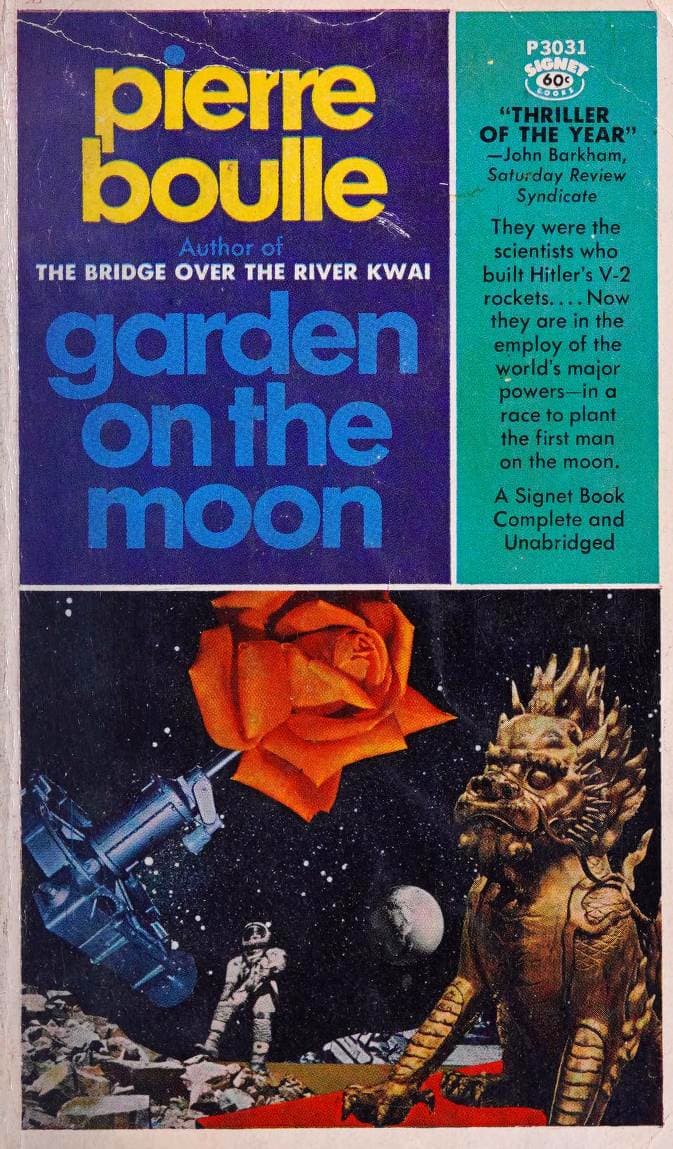
The Moon Belongs to the Gardener
Pierre Boulle published *Garden on the Moon* four years before Apollo 11 and managed to get the broad strokes of the space race almost embarrassingly right while missing the point of it entirely — which, sixty-one years later, turns out to be the most interesting thing about the book. The novel traces a German rocket scientist named Stern from Peenemünde through American citizenship, through Sputnik humiliation, through a Kennedy-like president's moon pledge, through the grinding bureaucratic and political machinery that either enables or suffocates grand technological ambition. Boulle understood, with considerable sophistication, that the moon race was never really about the moon. It was about national prestige laundered through engineering. He understood the role of captured German scientists in both superpowers' programs, the inter-service rivalries, the way politicians oscillate between grandiose promises and budget-cutting cowardice. He understood that public enthusiasm for space could evaporate the moment it competed with domestic spending. All of this reads like history now, not speculation. What he could not have known — what makes the book sting differently in 2026 — is that the oscillation he described would never stop. We are still in it. Artemis delays, shifting timelines, congressional haggling over NASA budgets, the entrance of private actors Boulle never imagined: the pattern he identified as dramatic tension has become permanent condition.
The novel's masterstroke, and the thing that separates it from a dozen other space race fictions of the era, is its ending. Neither America nor the Soviet Union lands first. Japan does — through a one-way mission by the aging Dr. Kanashima, who lands alone with no fuel for return, no rescue possible, and proceeds to build a Zen garden on the lunar surface with rocks and colored paper. He composes poetry. He drinks whisky. He watches the Earth rise. This is not a victory of engineering but of philosophy, and Boulle clearly means it as a rebuke to the superpower model of space conquest. In 1965, this was a charming twist. In 2026, it lands with unexpected weight. Japan's SLIM lander touched down on the moon in January 2024 — upside down, limping, but there. India's Chandrayaan-3 preceded it. The moon race has, in fact, become multipolar in exactly the way Boulle imagined, though he could not have predicted that the most dramatic entrant would be China rather than Japan, or that the private sector — SpaceX, Blue Origin — would displace much of the national apparatus he took as given. The superpower duopoly he satirized has genuinely fractured.