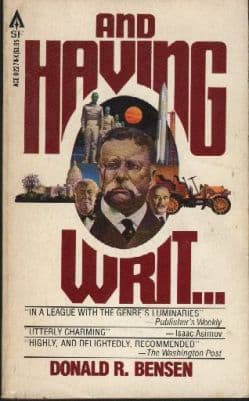
The Castaways Who Thought They Could Hurry History
Philip José Farmer's 1966 novel operates on a premise so cleanly absurd it nearly disguises its seriousness: four alien explorers crash-land on Earth in 1908, find themselves unable to leave, and decide the fastest way to get rescued is to accelerate human technological progress — by engineering a world war. They shuttle between Roosevelt, Edison, the Kaiser, the Czar, and Rasputin, deploying a fabricated Galactic Empire cover story and advanced medical technology as diplomatic currency, all in service of a Metahistorical theory that predicts civilizations advance fastest through catastrophic violence. The plan fails. They enter stasis. They wake to find humanity has leapfrogged anyway, inspired not by war but by the mere fact of extraterrestrial existence. It is a shaggy, episodic, frequently comic novel that nonetheless asks a question with real teeth: does progress require destruction, or is that just the story empires tell themselves?
From 2026, the prescience is selective but striking. Farmer anticipated the weaponization of media narratives around first contact — his aliens face hostile press coverage shaped entirely by partisan affiliation, with newspapers spinning their existence as either divine validation or existential labor-market threat. Replace "aliens" with any sufficiently disruptive technology and you have the last decade's media cycle almost exactly. The scene where Edison, elevated to the presidency by industrialists who believe he can best manage the alien visitors' knowledge, begins demanding their technical secrets under threat of confinement reads less like satire now than like a policy memo. The notion that a nation-state would imprison the bearers of transformative knowledge to extract it exclusively for strategic advantage is not speculative fiction in 2026; it is export control law. Farmer also grasped something subtler: that the presence of an undeniable external intelligence would not unify humanity immediately but would instead be metabolized through existing power structures, each faction trying to own the narrative. That the aliens' greatest impact turns out to be existential rather than technical — that knowing they existed changed what humans believed was possible — prefigures the way the search for extraterrestrial life has shifted from a scientific question to a cultural and psychological one.
The blind spots are era-typical but worth naming. Farmer's aliens are uniformly male-coded, and the novel's engagement with gender is limited to bemusement at Earth's "societal norms" — a phrase that does a lot of work while saying nothing. The absence of any female character with agency is not a feature of the 1908 setting; it is a feature of the 1966 author. Similarly, the novel's theory of Metahistory — that civilizations follow predictable developmental arcs accelerated by conflict — is a product of mid-century systems thinking, the kind of confident grand narrative that Farmer's contemporaries in the social sciences were building and that the subsequent sixty years have largely demolished. The idea that you could model a civilization's trajectory with sufficient data and then intervene at key pressure points is less Asimovian psychohistory than it is counterinsurgency doctrine, and it fails in the novel for the same reasons it fails in practice: people do not behave as their patterns predict. Farmer seems to know this — the plan's failure is the point — but the novel never fully interrogates why its aliens believed in Metahistory so completely in the first place, which is the more interesting question.