The Servant Problem, Revisited
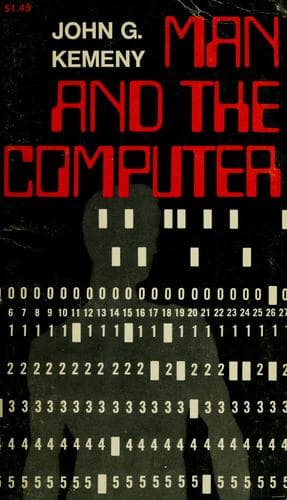
John Kemeny wrote this book in 1972 with the calm confidence of a man who had already built something that worked. He had co-invented BASIC, helped design the Dartmouth Time-Sharing System, and watched undergraduates — English majors, not engineers — sit down at terminals and write programs that ran. From that experience he extrapolated a future of home terminals, national computer networks, personalized news delivery, automated libraries, and a citizenry fluent in computational thinking. He framed the whole enterprise as symbiosis: two species, human and machine, each contributing what the other lacked. Speed and memory on one side. Judgment, intuition, and pattern recognition on the other. The metaphor is biological, deliberate, and — he would insist — not merely metaphorical. He spends real pages arguing that computers might qualify as a new species, that self-reproducing robots could initiate their own evolutionary line. In 1972 this was speculative but disciplined. In 2026 it reads like the first draft of a conversation we are now having in earnest, though with rather different vocabulary.
The prescience is remarkable in its specifics. Kemeny describes a system where reporters file stories into a computer, editors tag them by subject and priority, and readers at home terminals select what they want to read at whatever depth they choose — essentially RSS feeds, news apps, and algorithmic curation, minus the algorithm. He envisions computerized credit transactions replacing cash, inventory lookups from home, personalized education through interactive terminals, and a national reference library where users refine searches through iterative keyword dialogue with the machine. That last one is not a metaphor for Google Scholar; it is Google Scholar, plus the conversational refinement loop that now characterizes interactions with large language models. He predicted that computer communication traffic would eventually exceed telephone traffic. He was right, and the margin is absurd. His proposed network of seven regional computing centers serving eighty cities is structurally closer to cloud computing's geography than he could have known — though Amazon Web Services has rather more than seven.
What Kemeny could not see is what almost no one in 1972 could see: that the economics of attention would matter more than the economics of access. His entire framework assumes that the bottleneck is getting humans and computers into the same room, and that once you solve the access problem — cheap terminals, good networks, simple languages — the symbiosis naturally follows. He never imagines that people might have unlimited access to computation and use it primarily to argue with strangers, watch short videos, or generate slop. His citizens are earnest. They read their personalized newspapers carefully. They use home terminals to check store inventories and study calculus. The possibility that the computer might become the dominant partner in the relationship, shaping human attention rather than serving human intention, does not appear. Nor does surveillance capitalism, platform monopoly, or the weaponization of the very data-sharing he advocates. His chapter on privacy concerns is thoughtful but ultimately trusting: he believes oversight panels and good policy will handle it. The NSA, Facebook, and Clearview AI were not in his models. His blind spot is not technological but political — he assumes institutions will remain accountable as they become more powerful, a faith characteristic of midcentury American liberalism and the Ivy League presidency he would later hold.