The Building Knows What Time It Isn't
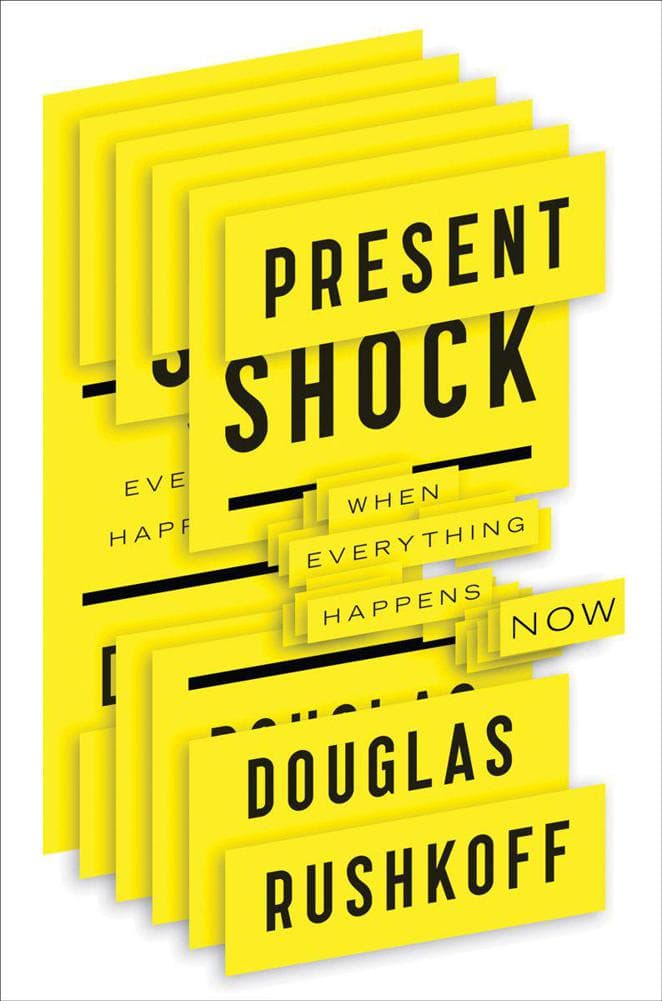
A book about the tyranny of the present has the misfortune of aging in the present. Published in 2025, *Present Shock* arrived at a moment when its core thesis — that we had traded narrative coherence for a kind of perpetual, twitching now — was already so ambient it risked feeling like weather. The concept of "digiphrenia," the splintering of self across competing digital timelines, read as diagnosis when it was written. Twelve months later, it reads as infrastructure. The 2026 rollout of persistent AI companions, always-on ambient computing in domestic spaces, and the quiet normalization of synthetic media in political campaigns didn't just confirm the book's anxieties — they made the book's framework feel almost quaint in its orderliness. The author taxonomized the chaos into neat chapters: Narrative Collapse, Digiphrenia, Overwinding, Fractalnoia, Apocalypto. The world, as it does, refused to stay in its sections. The collapse of narrative and the fractalnoiac pattern-seeking now feed each other in tight loops the book gestured toward but never fully mapped. What it got right was the *feel* of the condition. What it missed was how quickly the condition would learn to monetize itself.
The blind spots are instructive. The book assumes a subject who is, at baseline, trying to pay attention — someone besieged by distraction but still oriented toward coherence, still mourning the loss of linear narrative. That figure already feels historical. The generation coming up behind the book's implied reader doesn't mourn narrative collapse; they build inside it. Short-form video didn't just fragment storytelling, it generated new grammars of meaning that the book's framework has no vocabulary for. There is also a conspicuous absence: the book has almost nothing to say about labor. The "present shock" of the gig worker, the on-demand contractor, the person whose schedule is determined by algorithmic dispatch — this is the material base of the temporal disorientation the book describes, and it goes largely unexamined. The analysis stays cultural and cognitive when the engine is economic. That's a bias of its era, or maybe of its genre.
The chapter on "Overwinding" — the compression of time into ever-shorter cycles of response and consequence — hits differently after the spring 2026 flash crashes, which cascaded across interconnected AI trading systems faster than any human regulatory body could intervene. The book's sports-injury metaphor, bodies breaking down under the demand for constant performance, now extends cleanly to institutional systems themselves. The financial examples the author cited were illustrative; the ones we lived through were structural. Similarly, "Fractalnoia" gained a harder edge after the conspiracy-theory-driven disruptions to public health infrastructure this past winter. The book treated pattern-recognition-gone-wrong as a cognitive tendency. It turned out to be a political weapon, wielded with precision by actors who understood the feedback loops better than the people caught inside them.