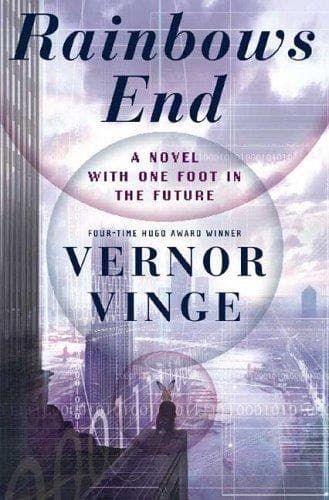
The Year We Were Supposed to Be Wearing
Vernor Vinge set his novel in 2025, and now it's 2026, and we can check his homework. The results are uneven in the way that matters most: he was right about the texture of the problem and wrong about the shape of the solution. The augmented reality layers he imagined—contact lenses painting the world with competing "belief circles," wearable computing stitched into clothing, the entire physical environment serving as a substrate for overlapping digital realities—remain aspirational. Apple Vision Pro sits in drawers. Meta's orchard of headsets has not produced the fruit Vinge envisioned. But the underlying condition he diagnosed—that consensus reality would fragment into tribal overlays, each group literally seeing a different world—is the defining feature of our information environment. We just do it with screens and feeds instead of smart contact lenses. The technology is cruder; the epistemological crisis is, if anything, worse than he imagined, because Vinge assumed the overlays would at least be computationally honest. He didn't anticipate that the belief circles wouldn't need AR hardware at all. Algorithmic curation did the job.
What Vinge got right with startling specificity: the hobbyist disease surveillance network that detects a pathogen before official agencies can respond. Replace "Pseudomimivirus" with "SARS-CoV-2" and "hobbyist network" with "genomic sequencing labs posting to Twitter and ProMED," and you have the early weeks of January 2020. The novel's treatment of biosecurity—the anxiety about precision bioweapons, the uncomfortable truth that gain-of-function research sits in an ambiguous zone between public health and existential threat—reads now less like science fiction and more like a congressional hearing transcript. His depiction of the intelligence community's inability to distinguish between legitimate research and weapons development is painfully current. The book's central MacGuffin, a technology for subtle cognitive influence delivered through biological vectors, maps uncomfortably onto real debates about dual-use research. Where Vinge faltered was in imagining that the institutional response would be competent, coordinated, and staffed by people like Alfred Vaz—ruthless but fundamentally serious. The actual pandemic revealed institutions that were neither.
The novel's emotional core—Robert Gu, a brilliant poet cured of Alzheimer's, who recovers his intellect but not his talent—has aged into something more poignant than Vinge probably intended. In 2007, this was a thought experiment about identity and cognitive enhancement. In 2026, with large language models generating passable verse on command, Robert's crisis is no longer hypothetical. The question is no longer "what if you lost your gift?" but "what if the gift itself became commodity?" Robert's simple spoken poem, momentarily captivating a classroom of students producing multimedia spectacles, now reads as an elegy for a kind of attention that may already be extinct. The students' augmented creative tools, which Vinge presented as overwhelming but ultimately shallow, look quaint next to generative AI. He imagined technology would make human creativity flashier. He didn't imagine it would make human creativity optional. Similarly, the Librareome Project—the digitization and destruction of physical library collections—was meant to provoke outrage. In practice, Google Books did a version of this, badly, and most people shrugged.