The Tutor in the Machine and the Tribe at the Gate
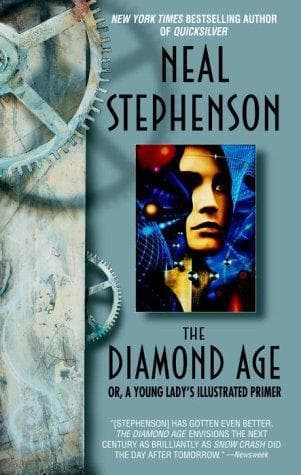
Stephenson's 1996 novel posits that the central problem of a post-scarcity civilization is not production but pedagogy — not what you can make, but what kind of person the making makes you. This turns out to be a better prediction than most of the nanotechnology. The Young Lady's Illustrated Primer, a book that watches its reader, adapts to her psychology, teaches her to code and to fight and to think in archetypes, is essentially a portrait of what we now call an AI tutor crossed with a personalized learning platform, animated by a human performer whose emotional labor holds the whole thing together. In 2026, with large language models generating bespoke educational content and adaptive learning systems proliferating through every school district that can afford them, the Primer reads less like speculation and more like a design document someone took too literally. What Stephenson got right is the hunger for it — the sense that a sufficiently responsive text could parent a child better than her circumstances allow. What he also got right, and what the edtech industry still refuses to internalize, is that the Primer only works because Miranda is on the other end. The machine needs a soul on retainer. Strip out the human ractor and you have a very expensive chatbot. We are currently running that experiment at scale.
The phyle system — voluntary tribal affiliations replacing the nation-state — is the novel's most structurally ambitious idea, and the one that has aged most strangely. In 1996 it read as libertarian fantasy, a thought experiment about what happens when group identity becomes elective and enforced by nanotech border security. In 2026, after watching the internet sort people into ideological enclaves with algorithmic precision, after seeing cryptocurrency communities attempt to build parallel governance structures, after observing how diaspora networks and online subcultures increasingly function as para-states with their own norms, currencies, and enforcement mechanisms, the phyle concept feels less like fantasy and more like an only slightly exaggerated ethnography of the present. The neo-Victorians choosing to organize around manners, hypocrisy, and a shared performance of civility are not so far from any number of communities that have decided the content of their culture matters more than the geography of their residence. Stephenson understood that the erosion of the nation-state wouldn't produce atomized individuals but rather a fierce, sometimes violent re-tribalization. He did not anticipate that the tribes would mostly form around content algorithms rather than conscious philosophical choice, which makes his version look almost noble by comparison.