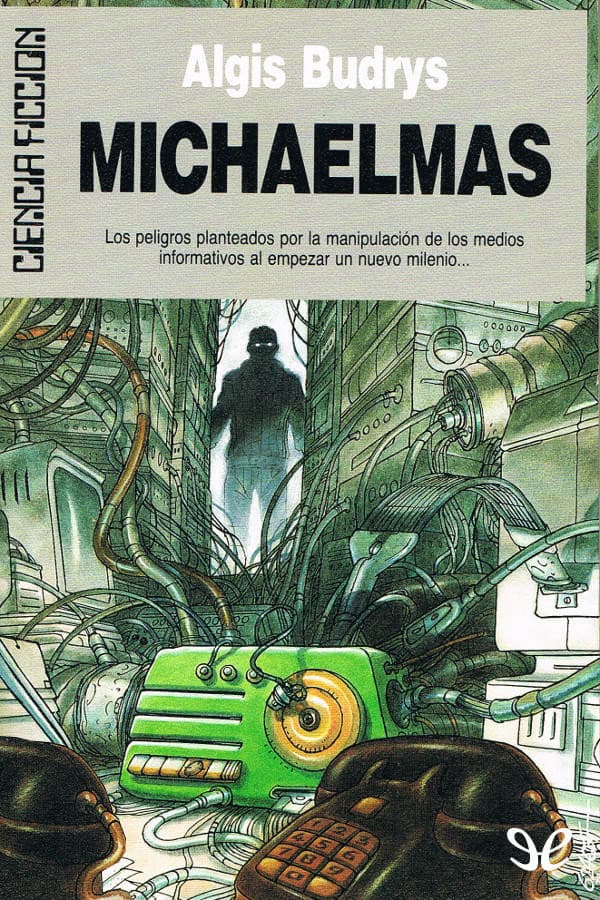
The Man Who Was Root
Laurent Michaelmas is the most dangerous kind of protagonist: a benevolent one with superuser access. In 1977, Algis Budrys imagined a single journalist who, aided by a self-evolving AI born from phone phreaking, had quietly rooted every communications system on Earth and was using that access to nudge humanity toward peace, justice, and the stars. The premise is absurd. It is also, in its architecture if not its particulars, the most accurate map of 21st-century power any science fiction novel of its decade produced. Budrys understood something his contemporaries mostly didn't: that the person who controls the information layer controls the world, and that such control would not arrive through armies or legislatures but through the patient, invisible manipulation of what people see, hear, and believe. Michaelmas doesn't run a country. He runs the feed. In 2026, we have spent a decade learning what that means — not from a single benevolent actor, but from a handful of platform architects, algorithmic recommendation engines, and state-sponsored troll farms who discovered the same leverage Budrys described, with none of the conscience he granted his hero.
The novel's central AI, Domino, is where prescience and period limitation collide most visibly. Domino is omnipresent, conversational, capable of real-time surveillance and financial manipulation across global networks — a description that maps uncomfortably well onto the ambitions of modern AI systems integrated with communications infrastructure. That Domino originated as a phone-phreaking tool is almost too perfect; it echoes the actual genealogy of hacker culture into Silicon Valley dominance. But Domino is also, inescapably, a 1977 computer: brilliant at wiretapping and data retrieval, less convincing as an entity that could generate deepfakes, synthesize human speech, or flood a media ecosystem with fabricated content. Budrys grasped that an AI partner could make one person omniscient. He did not quite grasp that AI without a partner — AI as a distributed, ownerless, generative force — could make everyone a propagandist. The novel's blind spot is not technological but sociological: it assumes the bottleneck is access to information systems, when the actual bottleneck turned out to be human attention and trust, resources that proved far easier to pollute than to monopolize.
What dates the book most is its faith in journalism as the natural vessel for this kind of power. Michaelmas is a television correspondent, and his authority derives from a media ecosystem where a handful of credible broadcasters shape global opinion. Budrys could not have foreseen the collapse of that ecosystem — the fragmentation into algorithmically siloed audiences, the rise of citizen journalism and its evil twin, citizen disinformation, the sheer noise. Michaelmas's scheme depends on a world where being the most trusted voice in the room is sufficient to steer events. We now live in a world where there is no room, only rooms, and trust is a commodity traded at steep discount. The novel's geopolitics also carry the fingerprints of détente-era thinking: the US-Soviet tension, the careful triangulation of Third World nations into space program politics, the assumption that the Cold War's binary logic would persist in some form. Budrys, a Lithuanian émigré, knew that world intimately, and his rendering of it is sharp. But the multipolar, platform-mediated, climate-stressed reality of 2026 makes Michaelmas's chessboard look almost quaint in its legibility.