The Republic as a Novel That Wrote Itself
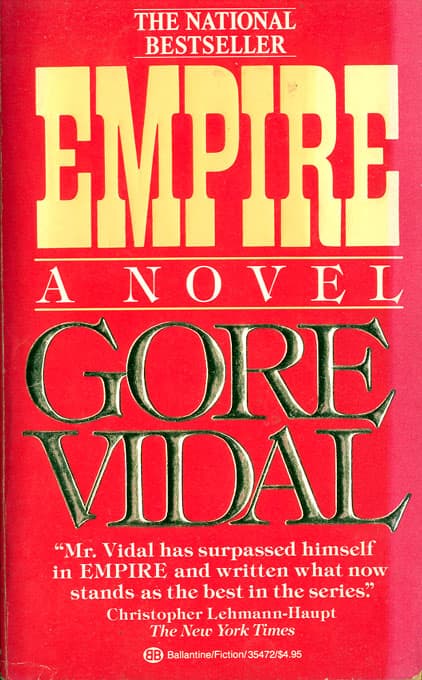
Vidal published this in 2002, which means he finished it in the long shadow of September 11th, though the book itself — being the final volume of his American Chronicles series, set between 1898 and 1906 — has nothing to do with that day and everything to do with it. The novel traces the birth of American empire through the Spanish-American War, the seizure of the Philippines, the assassination of McKinley, and Theodore Roosevelt's energetic ascent to a presidency that would remake the nation's relationship with the rest of the world. Vidal's argument, delivered not through polemic but through drawing rooms and newsrooms and Senate cloakrooms, is that the American republic died in the cradle of empire, and that what followed was a long performance of democratic theater staged by oligarchs, media barons, and military adventurers. In 2002, this read as a provocation. In 2026, it reads as a user manual someone lost behind the radiator.
The prescience is structural, not predictive. Vidal did not foresee social media or algorithmic radicalization, but he understood — through his portrait of William Randolph Hearst — that the person who controls the narrative apparatus controls the republic, and that this control has nothing to do with holding elected office. Hearst's climactic confrontation with Roosevelt, in which the newspaper magnate claims credit for inventing the wars and the presidents alike, lands with a force Vidal could not have fully intended. We have lived through multiple cycles of this now: media figures who shape political reality more decisively than any senator, who manufacture crises and then ride the outrage they've generated. Hearst tells Roosevelt he is the true emperor because he manufactures consent. Replace "newspaper" with "platform" and the scene barely needs updating. What Vidal got exactly right is that the machinery of empire and the machinery of spectacle are the same machine. What he couldn't imagine is that the machine would eventually dispense with the need for a single Hearst-like figure and distribute the function across millions of nodes, each one a little yellow press.
The blind spots are those of Vidal's class and generation, which is to say they are elegant blind spots. The novel is overwhelmingly white, overwhelmingly elite, and its one significant engagement with race — the revelation that Clarence King secretly married a Black woman — is treated as a curiosity of the upper crust rather than a window into the foundational violence of the republic. Vidal understood empire abroad but remained oddly incurious about empire at home, the domestic colonialism that would become impossible to ignore after 2020. His characters debate the Philippines with moral seriousness; they do not debate Jim Crow at all. This is not ignorance — Vidal knew the history — but it reveals the limits of his chosen lens. When you stage your critique of power exclusively in the salons where power dines, you reproduce some of the silences you claim to expose. Similarly, Vidal's conviction that the real contest was between a republic of laws and an empire of ambition now feels insufficient. The contest in 2026 is whether the concept of shared factual reality survives at all — a problem Hearst inaugurated but that has metastasized beyond anything Vidal's Enlightenment sensibility could accommodate.