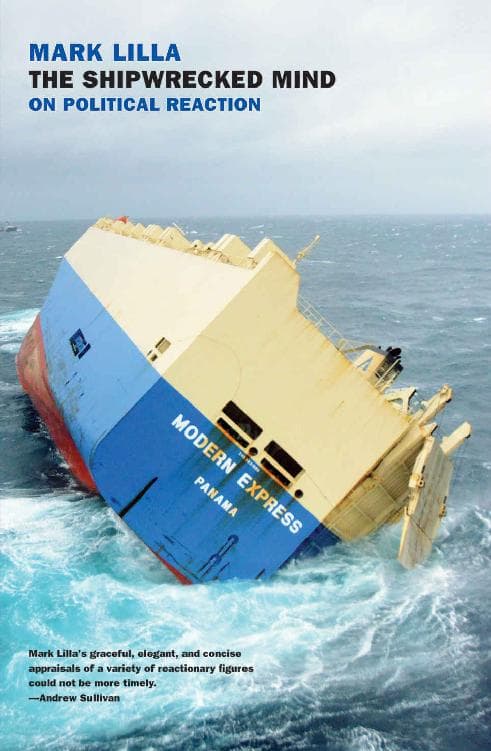
The Nostalgia Arms Race
Mark Lilla published *The Shipwrecked Mind* in 2016, the same year that nostalgia — militant, weaponized, draped in the language of civilizational loss — won a presidential election in the United States and a referendum in Britain. The timing was almost cruel. Here was a slim, elegant book of essays arguing that we had failed to take reactionary thought seriously as a political force, arriving just as that force kicked down the front door. Lilla had been assembling these pieces for years, mostly for *The New York Review of Books*, and the collection reads like a scholar calmly diagnosing a fever while the patient is already seizing. What he got right was the essential architecture: that reaction is not conservatism, that it possesses its own radical energy, that its motor is not a love of the past but a narrative of betrayal — the conviction that history took a catastrophic wrong turn and that someone, somewhere, is to blame. This framework has only become more indispensable. The decade since publication has been a masterclass in reactionary mobilization, from Orbán's Hungary to Meloni's Italy to the American right's full embrace of what Lilla would recognize as epochal thinking — the division of time into a golden age and a fallen present, with a great restoration always just one election away.
What Lilla anticipated with uncanny precision was the structure of feeling, not the specific machinery. His chapter on the French reaction after the 2015 *Charlie Hebdo* attacks — analyzing Éric Zemmour's *Le Suicide français* and Houellebecq's *Soumission* — now reads as a near-perfect template for the populist-intellectual feedback loop that has since replicated itself across the West. Zemmour went on to run for the French presidency in 2022. Houellebecq became, if anything, more central to the discourse. The "new reactionary" current Lilla identified in Parisian intellectual life was not a French peculiarity; it was a pilot program. His insight that these figures are not throwbacks but modern creatures — media-savvy, ironic, deploying nostalgia as a weapon rather than inhabiting it as a mood — has aged extremely well. Less prescient was his framing of reaction as primarily an intellectual phenomenon, a matter of thinkers and their ideas. The decade's lesson has been that reactionary energy does not require Voegelin or Strauss. It requires algorithms. The shipwrecked mind, it turns out, scales beautifully through recommendation engines and short-form video, and the nostalgia narrative can be assembled from memes and vibes as effectively as from philosophical treatises. Lilla was writing about the officers. The enlisted were already mobilizing through channels he did not examine.