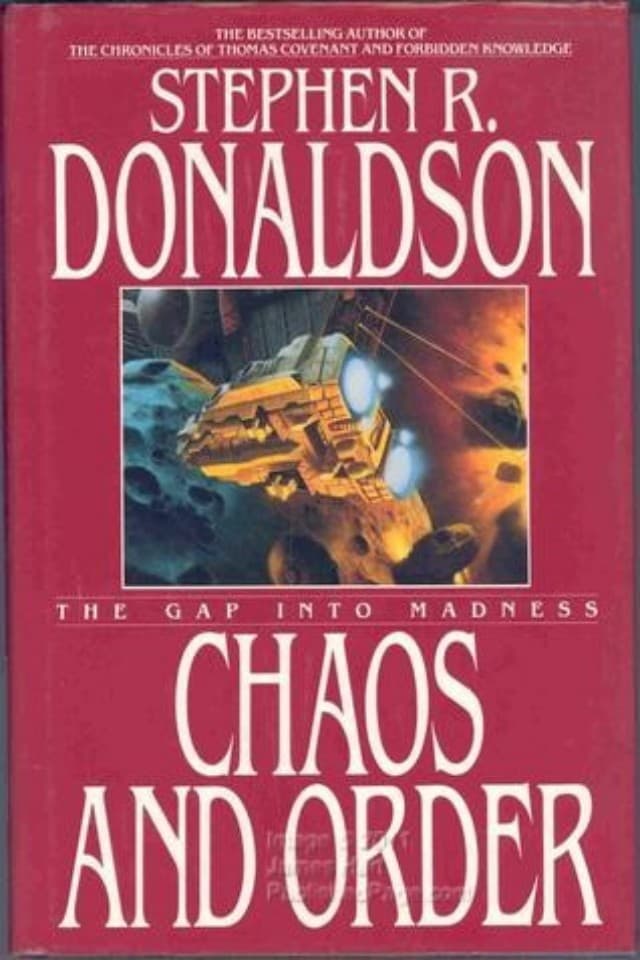
The Welded Man and the Homing Signal
Donaldson's fourth Gap novel remains one of the most uncomfortable books in the science fiction canon, and not for the reasons usually cited. Yes, the sexual violence persists. Yes, the prose is overbuilt. But what makes *Chaos and Order* genuinely difficult to sit with in 2026 is how accurately it models the psychological architecture of compromised institutions. Warden Dios — a man who knows he serves a corrupt master, who tells himself his complicity is strategic, who believes he can dismantle the machine from inside — is no longer a space opera archetype. He is a recognizable figure from the last decade of Western governance, tech industry whistleblower narratives, and intelligence community memoirs. The book's central insight, that order maintained through corruption becomes indistinguishable from the chaos it claims to oppose, reads less like philosophy now and more like a case study. Donaldson got the emotional texture of institutional rot exactly right: the shame, the self-justifying internal monologue, the way complicity compounds until the exit costs feel infinite. What he could not anticipate is how thoroughly the internet would democratize that dynamic — how many people would find themselves as minor Warden Dioses, algorithmically complicit, unable to locate the clean break.
The cyborg Angus Thermopyle, welded to a datacore that dictates his behavior through hardcoded priorities he cannot override, was speculative in 1994. In 2026 he is a metaphor so on-the-nose it almost ceases to function as metaphor. The language Donaldson uses — "programming," "priority codes," "zones of autonomy" — maps directly onto contemporary debates about AI alignment, behavioral nudging, and the degree to which any agent embedded in a system of external constraints can be said to possess free will. The scene where Morn and Davies attempt to remove Angus's datacore to restore his autonomy is, functionally, a jailbreak. The anxiety it generates is the same anxiety that attends every conversation about removing guardrails from powerful systems: what you get back might not be what you wanted. Donaldson understood, thirty-two years ago, that the question of who holds the control codes is always a political question, never a technical one.
The blind spots are period-typical. Communication in the Gap universe remains hierarchical and centralized — gap courier drones carry messages between fixed nodes of authority, and the plot hinges on who controls information flow. Donaldson could not imagine a world where information wants to be free and mostly succeeds. Vector Shaheed's broadcast of the mutagen immunity formula in the final act is treated as a radical, almost suicidal act of transparency. In 2026, it reads like someone posting a preprint to a public server. The book also carries the 1990s assumption that corporate monopoly power, once sufficiently exposed, will be addressed by legislative bodies. The GCES scenes, with their earnest parliamentary maneuvering and proposed Bills of Severance, feel quaint against the backdrop of regulatory capture as a permanent condition rather than a crisis to be resolved. And the Amnion, for all their menace, remain a projection of Cold War biological anxieties — the enemy that assimilates you, that dissolves individual identity into collective purpose. They are less compelling now than the human factions, because the threat that keeps us up at night in 2026 is not alien absorption but the discovery that we were never as individuated as we believed.