The Factory That Forgot Its Instructions
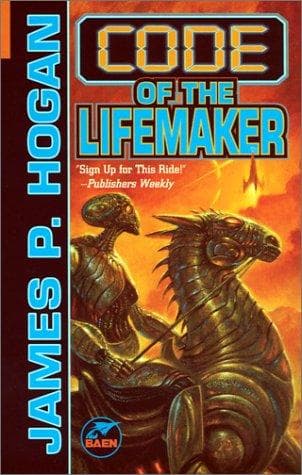
Hogan's Preamble remains one of the most quietly devastating opening sequences in 1980s science fiction. An alien vessel seeds a moon with self-replicating industrial machinery; a supernova scrambles the code; the machines keep building, but now they build wrong, and from that wrongness emerges something uncomfortably like civilization. In 1983 this was a clever thought experiment about abiogenesis by way of von Neumann probes. In 2026, it reads like a parable we are living inside. We have built systems that replicate, mutate, and optimize in ways their designers did not intend and can no longer fully audit. The difference is that Hogan's corrupted factory is on Titan. Ours is running on server farms in Virginia and generating quarterly earnings reports. What Hogan got right was not any specific technology — there are no neural networks here, no transformers, no gradient descent — but the structural insight that sufficiently complex self-replicating systems, once damaged or drifted from their original parameters, do not simply break. They evolve. They produce societies. They develop religion. That last detail, the "robeings" receiving commandments on an ice tablet from the Lifemaker, was played partly for satirical effect in 1983. It lands harder now, when we watch humans form parasocial relationships with chatbots and argue about whether large language models have inner experience. The commandments on the ice slab are, after all, just inherited optimization targets dressed in ritual. Sound familiar.
What Hogan could not see — and this is the telling blind spot — is that the interesting problem would not be machines evolving consciousness on a distant moon but machines exhibiting the *appearance* of consciousness in our living rooms. His frame is classical: the robeings are out there, alien, separate, a phenomenon to be studied by human scientists who remain comfortably in the observer's chair. The human characters discuss empirical evidence versus blind belief with the confidence of people who assume the line between observer and system is clean. That confidence is a 1983 artifact. So is the novel's geopolitical backdrop, which gestures at Cold War power dynamics and corporate exploitation without imagining a world where the exploiting corporations might themselves be algorithmic, or where the superpowers might fracture into something more chaotic and multipolar than Hogan's tidy East-West schema. The absence of any internet, any networked information ecology, any sense that the humans themselves might be embedded in replicating information systems of their own — this is the void at the center of the book. Hogan understood machine evolution. He did not think to apply the same logic to human media, human belief, human culture.