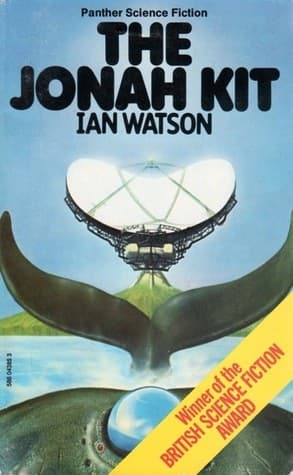
The Whale That Swallowed the Observer
Let us be precise about one thing: Ian Watson published *The Jonah Kit* in 1975, not 2014, and Enzensberger had nothing to do with it. The metadata is wrong, but the book is not, and forty-some years of wrongness have only sharpened its edges. Watson wrote a novel about imprinting a dying Soviet cosmonaut's consciousness into the brain of a sperm whale, and then he wrapped that premise in Cold War espionage, cosmological heresy, cetacean phenomenology, and a mass whale suicide that functions as both ecological protest and metaphysical exit. In 1975 this was ambitious speculative fiction. In 2026 it reads like a systems diagram of every anxiety we failed to take seriously. The novel's central scientific conceit — that whales form a distributed biological computer, a "Thought Complex" capable of processing abstract data through collective cognition — now sits uncomfortably close to genuine research into cetacean neural networks, the mounting evidence of sperm whale "alphabets" documented by Project CETI, and the broader computational turn in how we model animal intelligence. Watson didn't predict the specific tools (machine learning applied to bioacoustic data, the click-by-click decoding efforts that accelerated after 2021), but he got the shape of the question exactly right: what if the ocean already contains minds we have been too structurally arrogant to recognize? The Thought Star, with its seven whales synchronizing glyphs of awareness, is not so far from what researchers now cautiously describe when they talk about coordinated vocal exchanges among sperm whale social units. Watson also anticipated, with startling accuracy, the way such a discovery would be immediately conscripted by military and intelligence apparatus — not for wonder, but for strategic advantage. The scenes of American and Soviet operatives haggling over the boy Nilin, each side less interested in consciousness than in computational leverage, could have been written yesterday about the geopolitical scramble over AI capability.
Where Watson's Hammond subplot proves most corrosive in hindsight is in its treatment of the public reception of paradigm-shattering science. Hammond announces mathematical proof that the universe is not what orthodox cosmology claims, and the response is not enlightenment but cult formation, hysteria, motorcycle gangs, and a priest begging for meaning. The crowd at Mount Mezapico, mesmerized by a light machine, barely processing the content of the discovery, fixating instead on its emotional residue — this is the epistemological landscape of 2026 rendered in 1975 pigments. We have watched, repeatedly, how genuine scientific disruption (pandemic virology, climate modeling, AI alignment research) gets metabolized not through understanding but through narrative capture, tribal sorting, and spectacle. Watson saw that the problem was never the discovery. The problem was always the observer. Morelli's invocation of Schrödinger's Cat and the role of consciousness in collapsing reality was, at the time, a fashionable quantum mysticism riff. Now it reads differently — less as physics and more as sociology. We do, collectively, choose which branch of reality to inhabit. We do it every day, with our attention, our algorithms, our refusals.