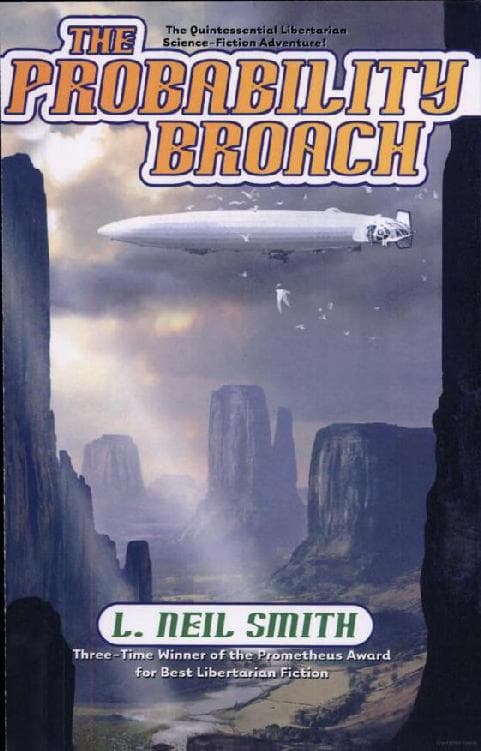
The Revolution Will Be Open-Carry
L. Neil Smith wrote *The Probability Broach* in 1977, published it in 1980, and set its dystopian "our world" chapters in 1987 — a future so close he could almost touch it, and so grim he clearly relished the contrast with his anarcho-capitalist utopia on the other side of the dimensional rift. The setup is familiar enough: a weary cop in a decaying America stumbles through a portal into a parallel world where the Whiskey Rebellion succeeded, Albert Gallatin replaced the Constitution with something closer to a libertarian fever dream, and everyone carries guns, pays no taxes, and lives to be two hundred. What's striking in 2026 is not the fantasy itself but the specific anxieties that generated it. Smith was writing in the aftermath of Watergate, stagflation, and the Church Committee revelations. His dystopian Denver — surveillance-saturated, economically hollowed, its public institutions crumbling under authoritarian austerity — reads less like 1987 and more like a composite sketch of grievances that have only intensified. Government seizure of corporations for retroactive tax violations? That sounded paranoid in 1980. It sounds like a Tuesday headline now, depending on which administration is in power and which tech company has fallen out of favor. The bugged offices, the hit-and-run assassinations of inconvenient officials, the casual lethality of state actors — Smith was extrapolating from COINTELPRO. He landed somewhere uncomfortably close to the documented playbook of several governments currently operating in the open.
Where Smith genuinely saw around corners was in technology and its relationship to power. His alternate world features something very like the internet — a ubiquitous "Telecom" network used for commerce, communication, forensic analysis, and what amounts to remote work. He imagined a society where most people work from home and value personal territory, connected by screens rather than commutes. He described DRM-free digital publishing in his own e-book preface with the zeal of a man who understood, decades early, that the container matters as much as the content. He even gestured toward the idea that accessible literature during economic hardship constitutes a political act. The Probability Broach itself — a device that opens a window between parallel realities — is less interesting as science fiction than as metaphor: Smith was arguing that the ability to *see* an alternative is itself revolutionary, that the most dangerous technology is the one that makes people realize their present is not inevitable. This is, functionally, the argument for the open internet, made before the internet existed.