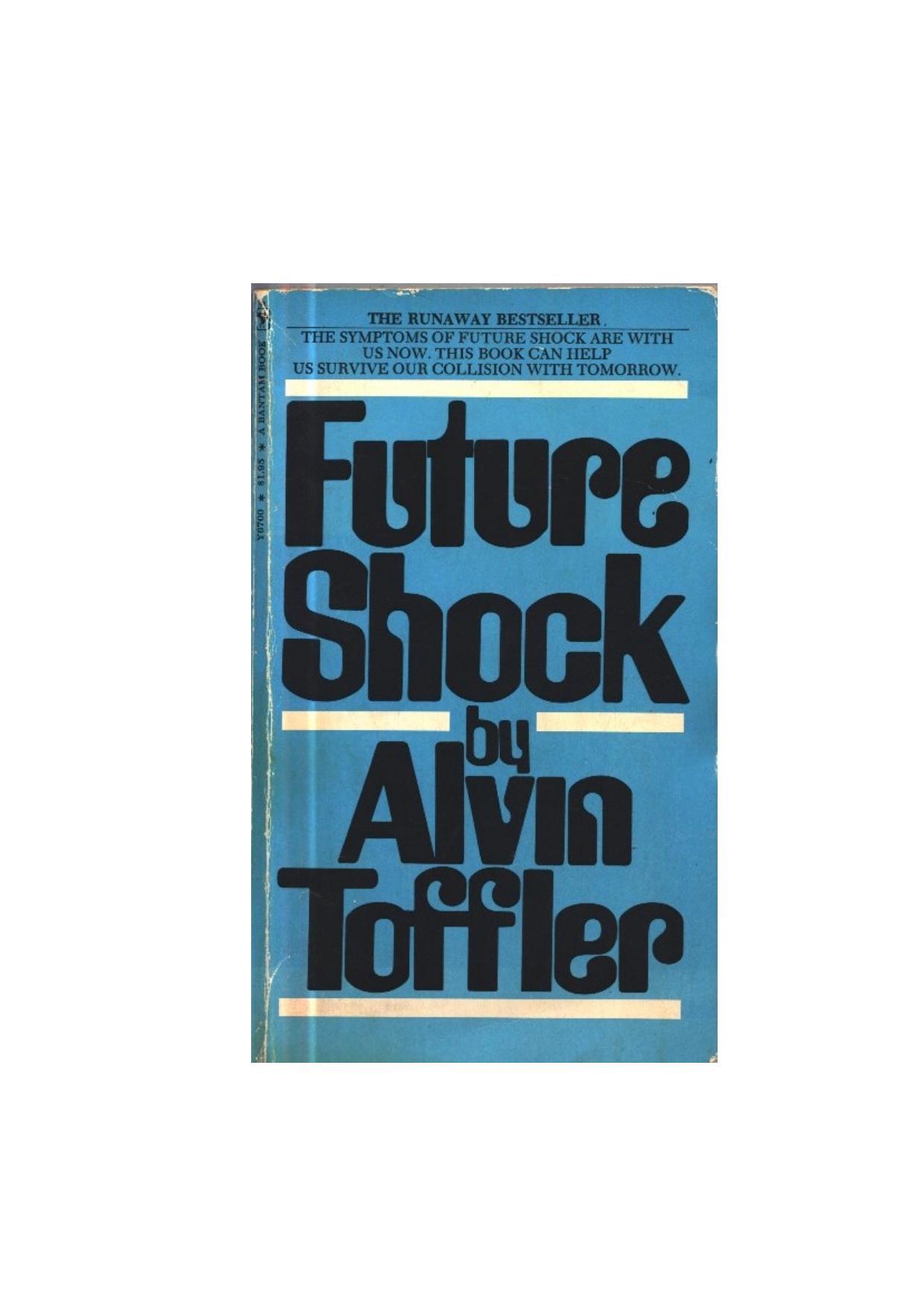
The Disease Was Real; the Prognosis Was Off
Alvin Toffler diagnosed a condition in 1970 that most people wouldn't have a vocabulary for until decades later. "Future shock" — the psychobiological distress of too much change in too little time — now reads less like a speculative coinage and more like a clinical description of the early twenty-first century. The book's core thesis, that the acceleration of technological and social change would outrun human adaptive capacity, has been validated so thoroughly that restating it feels redundant. We have anxiety epidemics, decision fatigue as a recognized phenomenon, doomscrolling as a verb. The Holmes-Rahe Life-Change Units Scale that Toffler cited in Chapter 15 now looks quaint beside the ambient, continuous disruption of algorithmic feeds that restructure attention on a minute-by-minute basis. He predicted the throwaway society, the modular relationship, the new nomadism, the fracturing of consensus into subcultural identities — and he predicted them with enough structural specificity that you can draw direct lines to gig work, parasocial influencer economies, digital nomad visas, and the proliferation of micro-communities on platforms he could not have named. The "ad-hocracy" of Chapter 7, his vision of fluid, project-based organizations replacing rigid bureaucracies, is a reasonable sketch of the startup ecosystem and the platform-mediated labor market. He saw overchoice before anyone had to pick a streaming service. He saw the "psychologization" of production — goods valued for their experiential and emotional payload — before the entire direct-to-consumer economy was built on brand narrative and identity signaling. These are not lucky guesses. They follow from a structural analysis of acceleration that remains, in its broad strokes, correct.
What Toffler could not see, or chose not to see, is equally instructive. The book is relentlessly Western, relentlessly affluent, and relentlessly optimistic about the directionality of progress even as it warns about its speed. The future it fears is one of too much abundance, too much freedom, too much novelty. There is almost nothing about ecological collapse as a systemic constraint on acceleration — the environmental crisis appears only as a backdrop for policy discussion, never as the defining material limit it has become. Climate change, resource depletion, and biodiversity loss are not speed problems; they are accumulation problems, and Toffler's framework, built around the pace of change rather than its metabolic consequences, has no real way to account for them. Equally absent is any serious reckoning with surveillance, data extraction, or the possibility that the information revolution would produce not just overchoice but manipulation at scale. He imagined consumers overwhelmed by options; he did not imagine consumers shaped, in real time, by systems designed to narrow their choices while maintaining the illusion of abundance. The internet does not appear, of course — but more telling is that the *logic* of the internet, the feedback loop between data collection, behavioral prediction, and automated persuasion, is outside his conceptual horizon. His "Modular Man" is lonely but free. Ours is modular and tracked.