The Wolfling's Mirror
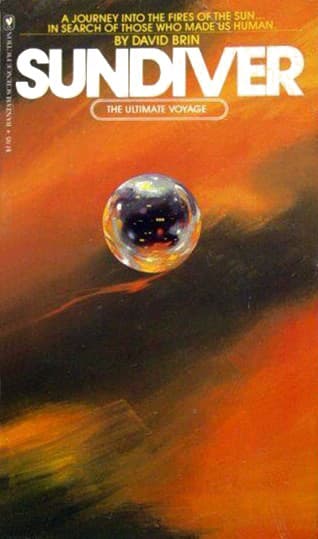
Sundiver is a novel that opens with a man driving a mechanical whale and closes with the revelation that the real monsters were the bureaucrats and their alien co-conspirators all along. Between these two points, David Brin built the scaffolding for what would become one of science fiction's more durable thought experiments: the Uplift universe, in which every intelligent species in the galaxy owes its sapience to a patron race that genetically engineered it upward — every species except, possibly, humanity. In 1980, this was a clever inversion of the ancient astronaut hypothesis then percolating through popular culture via von Däniken and Sitchin. In 2026, it reads as something more layered and more uncomfortable: a parable about what it means to enter an established order without credentials, without lineage, without anyone willing to vouch for you.
The novel's most striking act of prescience is not technological but sociopolitical. Brin imagined a galactic civilization organized around patronage, hierarchy, and access to a shared Library — a vast repository of accumulated knowledge that species consult before innovating, and which subtly discourages original thought. The Library is not the internet, exactly, but it rhymes with it in ways Brin could not have intended. The dynamic he describes — where reliance on an existing knowledge base becomes a substitute for direct investigation, where the species that consult the Library most faithfully are the least capable of adapting when it fails them — maps uncomfortably well onto our current relationship with large language models and search engines. When the Galactic-designed systems aboard the Sunship fail and it is older, cruder, human-built technology that saves the crew, Brin was writing a paean to empiricism over received wisdom. Forty-six years later, we are watching institutions rediscover this lesson in real time. What Brin missed, or chose not to explore, is the seductiveness of the Library itself — the way dependency on it might not feel like dependency at all, but like competence.
The dolphin uplift subplot is where the novel's age shows most visibly. Brin's dolphins are poetic, intelligent, straining at the leash of language — a vision rooted in the John Lilly-era optimism about cetacean cognition that was already fraying by the mid-1980s. The tension he dramatizes between preserving the dolphins' "natural" poetic nature and engineering them toward human-compatible intelligence anticipates real debates about AI alignment and cognitive enhancement, but the framing is unmistakably of its time: paternalistic, gently colonial, confident that the uplifters' intentions are fundamentally good. The gender dynamics aboard the Sunship, where Brin devotes an entire chapter to explaining why women dominate starship crews through a mix of biological and sociopolitical reasoning, read as an earnest attempt at progressivism that now feels like a man carefully showing his work on a problem he suspects he hasn't fully solved. He was right to suspect. The absence that dates the book most sharply is computational: there is no artificial intelligence of consequence, no networked information environment, no sense that the most transformative technology of the next half-century would be neither genetic engineering nor solar physics but the humble microprocessor and its descendants.