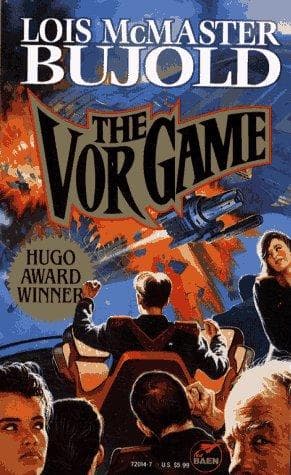
The Emperor in the Dumpster
There is a moment in *The Vor Game* where the Emperor of Barrayar — hereditary ruler of three planets, linchpin of an interstellar military empire — is found hiding in a drainpipe on a space station, having gone AWOL from his own throne. It's played for adventure, for stakes, for the particular Bujoldian mix of comedy and consequence. But thirty-five years later, reading it in a world where heads of state livestream their instability and governance sometimes feels like an improv exercise, the image lands with a different weight. Gregor's flight from duty isn't a fantastical what-if. It's a Tuesday. Bujold understood, in 1991, that the people at the apex of power structures are often the most psychologically trapped by them, and that the fragility of one person's will can destabilize entire systems. She wrote this before social media made the interior lives of leaders everyone's spectator sport, before we watched real-time the consequences of executive temperament on geopolitical stability. The novel's treatment of Gregor's depression and paralysis as a genuine security crisis — not a character flaw to be mocked but a structural vulnerability to be managed — now reads less like space opera and more like a briefing document.
What Bujold got right about military and mercenary organizations is striking in its specificity. The Dendarii Free Mercenary Fleet operates as a deniable asset, loyal to a state that cannot publicly acknowledge it — a private military company before the term entered common parlance. Miles commands through personal charisma, improvisation, and a network of informal loyalties rather than through any coherent institutional mandate. In 1991, this was clever worldbuilding. After three decades of Blackwater, Wagner Group, and the general privatization of state violence, it reads as diagnosis. The novel's portrait of how such organizations function — held together by the personality of a single leader, riven by internal factions, simultaneously indispensable to and disavowed by their sponsors — maps uncomfortably well onto realities Bujold could not have been directly extrapolating from. She was writing about the logic of feudalism projected into space, but feudalism, it turns out, was not as dead as 1991 thought it was.
The blind spots are the ones you'd expect from the early nineties, and they're almost charming in their optimism. Information technology barely registers as a force. Miles manipulates people face-to-face, in rooms, through sheer verbal dexterity; there is no sense that surveillance, data analysis, or networked communication might reshape the landscape of command. The Cetagandan threat is monolithic, legible, a recognizable empire with recognizable ambitions — the novel cannot imagine the diffuse, asymmetric, algorithmically amplified forms of conflict that define our era. And the political economy is curiously frictionless: mercenary fleets need funding, but the mechanics of that funding remain conveniently offstage. Bujold's universe runs on loyalty and cleverness. Ours increasingly runs on capital flows and automated systems that are indifferent to both.