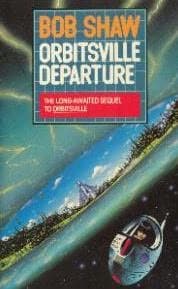
The Green Light at the Edge of Leaving
Bob Shaw wrote Orbitsville Departure in the final breath of the Cold War, when the dominant anxiety was still about what humanity might do with too much space rather than too little. The novel's central conceit — a Dyson sphere so vast it renders Earth irrelevant, yet people still manage to be petty, addicted, murderous, and bureaucratically entangled — reads in 2026 less like space opera and more like a parable about abundance that fails to cure anything. Shaw understood something we are only now articulating clearly: that the problem was never scarcity of territory or resources but the recursive loops of human damage. Dallen's wife is brain-wiped into infantile regression. Mathieu is a small-time embezzler whose crime escalates into something unforgivable. The Dyson sphere hums with indifference. The humans inside it replay the oldest scripts. Thirty-five years later, we live in an information environment of near-infinite surface area — not a shell of Dorian-grey material but a shell of screens — and the pathologies Shaw dramatized have only become more legible.
What Shaw anticipated with uncomfortable accuracy is the texture of life inside systems too large to comprehend. His Orbitsville is administered by declining municipal governments hemorrhaging revenue, populated by people who have drifted away from official structures into off-grid communities, surveilled incompletely by underfunded law enforcement. Replace "Orbitsville" with "platform" and "Madison City" with any mid-sized American municipality and the picture snaps into focus. The holomorph projections that confuse Dallen's bomb investigation on 1990 Street — indistinguishable from real people except by indirect evidence like footprints in wet pavement — are a strikingly precise anticipation of deepfake and mixed-reality environments. Shaw didn't have the vocabulary, but he had the problem: how do you verify the real when the synthetic is spatially coextensive with it? His answer, characteristically blunt, is that you look at the ground. You check for weight. That remains better advice than most of what the AI-detection industry has produced.
The blind spots are era-typical. Shaw's future is overwhelmingly white, heterosexual, and organized around nuclear family units whose dissolution is treated as the worst imaginable trauma. Women exist primarily as objects of grief (Cona), romantic complication (Silvia London), or brief functional appearance (Jean Antony, who gets one chapter of genuine agency before the narrative forgets her). The drug dependency subplot — Mathieu's felicitin addiction — is handled with a Reagan-era moralism that now feels quaint; the drug is a crutch, the user is weak, recovery is a matter of willpower triggered by a plane crash. There is no systemic analysis, no recognition of the pharmaceutical infrastructure that would create and distribute such a substance. Shaw also cannot imagine a future without physical offices, paper-adjacent bureaucracy, and men flying small aircraft to meetings. The communication technology is oddly stunted for a civilization that built a Dyson sphere. No one texts. No one scrolls. The loneliness in this book is the loneliness of rooms, not feeds.