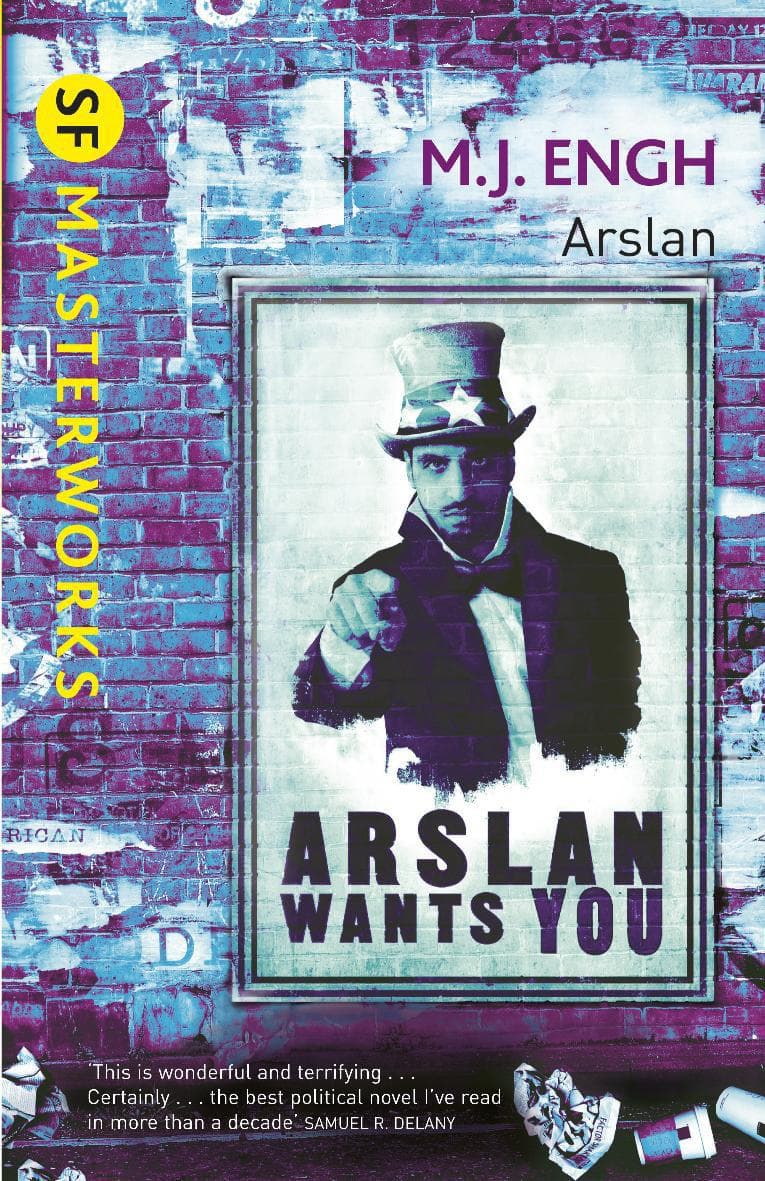
The Conqueror Who Moved In
Arslan is a novel about the end of the world that takes place almost entirely in one house. M.J. Engh understood something that most apocalyptic fiction still refuses to learn: that the collapse of civilization is not an event but a cohabitation. Her dictator doesn't nuke a city or unleash a plague. He moves into a school principal's spare bedroom in Illinois and starts eating dinner with the family. The horror is domestic. The power is intimate. And forty-one years later, the book reads less like speculative fiction and more like a case study in how populations actually behave under occupation — not with cinematic resistance, but with meal planning, curfew compliance, and the slow psychological corrosion of sharing space with your oppressor. Engh published this during Reagan's second term, when American fiction about conquest meant Red Dawn, not a Turkistani general billeted in your guest room. She chose the harder, truer version.
What Engh anticipated with uncomfortable precision is the mechanics of acquiescence. Not collaboration in the dramatic sense — no one signs a treaty — but the way ordinary administrative competence becomes the scaffolding of authoritarian rule. Franklin Bond, the school principal, is conscripted not as a soldier but as an economic planner. He keeps the county running. He manages grain distribution. He is, functionally, a middle manager of occupation, and he never stops thinking of himself as a good man. This pattern has replayed across the early 2020s in ways Engh could not have known but clearly intuited: the bureaucrats who implement, the technicians who optimize, the civic leaders who cooperate to "minimize harm" and thereby normalize what should remain abnormal. The novel also grasps something about charismatic authoritarianism that remains undertheorized — that Arslan's power is not merely coercive but seductive, not merely political but erotic. The sexual violence in the book is not incidental to the political conquest; it is the political conquest expressed at its most irreducible scale. The body is the last territory.
The blind spots are real but specific. Engh's geopolitics are rooted in Cold War architecture — the Soviet antimissile laser, the bilateral superpower framework, the idea that a single brilliant tactician could exploit the seam between Washington and Moscow to seize global control. This reads as dated now, not because the scenario is impossible but because the actual mechanisms of global disruption turned out to be more diffuse: cyberattacks, supply chain weaponization, information warfare, pandemic logistics. Arslan conquers the world through a combination of military genius and diplomatic blackmail. The 2020s have shown that you don't need genius; you need leverage over semiconductors, or energy pipelines, or social media algorithms. Engh also has almost nothing to say about digital communication or surveillance — understandable for 1985, but it means her occupation operates through physical presence and direct command in ways that feel pre-modern. The absence of any information ecosystem beyond word of mouth makes Kraftsville's isolation more plausible than it should be. What she couldn't imagine is that the occupied wouldn't need to be cut off from information — they'd drown in it and still comply.