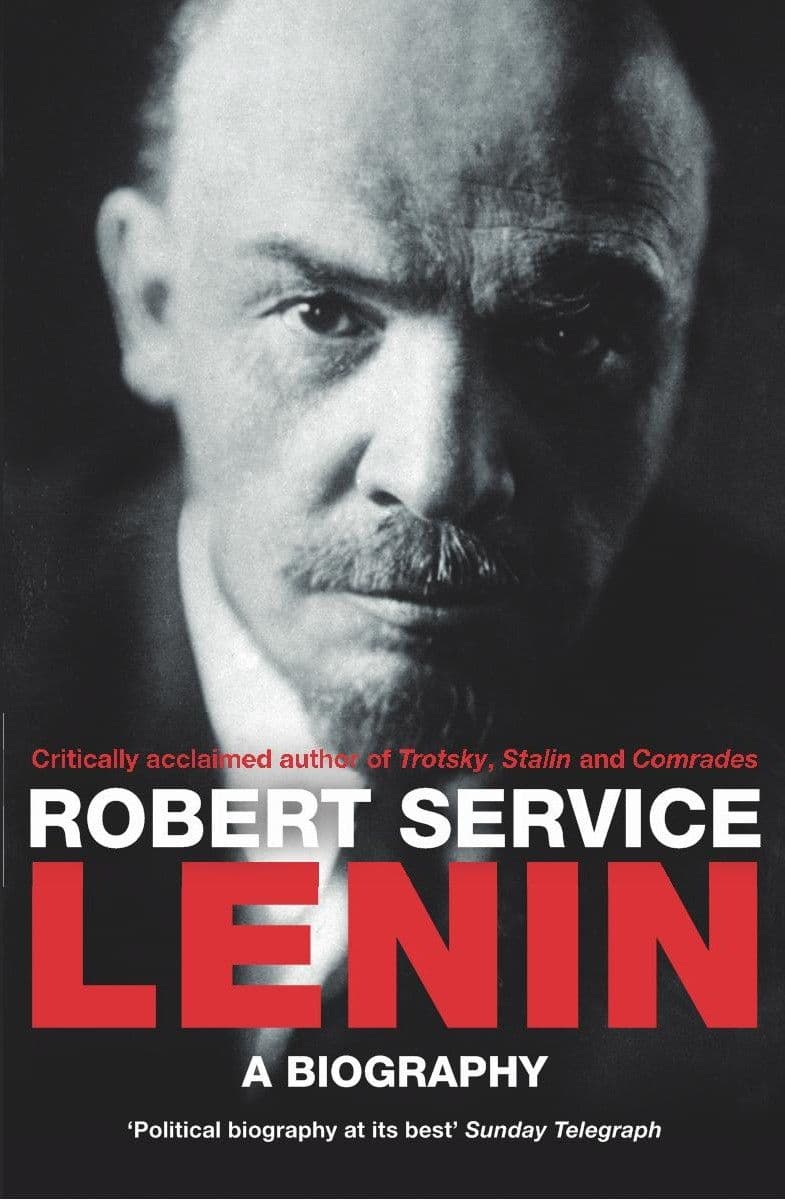
The Machinery of a Man Who Became a System
Robert Service published his Lenin in 2000, which is to say he published it in the intermission. The Soviet Union had been dead for nine years. The War on Terror had not yet begun. Liberal democracy appeared, to most Western observers, to be the only remaining operating system. Into this lull Service delivered a biography that insisted, with considerable archival patience, that Lenin was not an abstraction but a person — irritable, calculating, prone to migraines, capable of tenderness toward cats and cruelty toward comrades in the same afternoon. The book's central achievement was deflationary: it took the icon apart without replacing it with a cartoon. Service had access to archives that earlier biographers could only guess at, and he used them not to prosecute Lenin but to anatomize him. The result was a portrait of a man whose political genius was inseparable from his pathologies — his need for control, his contempt for procedural constraint, his willingness to subordinate every human relationship to strategic advantage. In 2000, this felt like a postmortem. In 2026, it reads more like a diagnostic manual.
What Service anticipated, without quite naming it, was the template. Lenin as he appears in these pages — the disciplined factional operator who understood that capturing institutions mattered more than winning arguments, who built parallel structures while his opponents debated principles, who treated language as a tool for mobilization rather than communication — is now recognizable not as a historical curiosity but as a recurring type. The playbook Service documents has been run, with local variations, across multiple continents in the years since publication. The organizational methods, the rhetoric of emergency, the insistence that procedural norms are bourgeois luxuries — none of this stayed buried in the twentieth century. Service could not have foreseen the specific actors or the digital infrastructure that would amplify these tactics, but the grammar he identified has proven distressingly portable. He got the mechanics right. What he missed, understandably, was the medium: he could not have imagined that the pamphlet would become the algorithm, that Iskra would become a feed.
The book's blind spots are the blind spots of its moment. Service wrote from within the End of History consensus, and while he was too careful a historian to make triumphalist claims, the biography carries an ambient assumption that Leninism was a solved problem — a phenomenon to be explained rather than a pattern to be guarded against. There is little in the book about how democratic societies might prove vulnerable to the same structural pressures Lenin exploited. The chapters on Lenin's manipulation of democratic centralism, his hollowing out of party institutions from within, his weaponization of grievance — these sections now carry a weight that Service did not load onto them. He was writing history. History, as it turns out, was taking notes. The absence of any sustained reflection on information warfare is also conspicuous, though forgivable; in 2000, the internet was still largely understood as a democratizing force, not a tool for the kind of disciplined propaganda operations Lenin would have recognized instantly and admired.