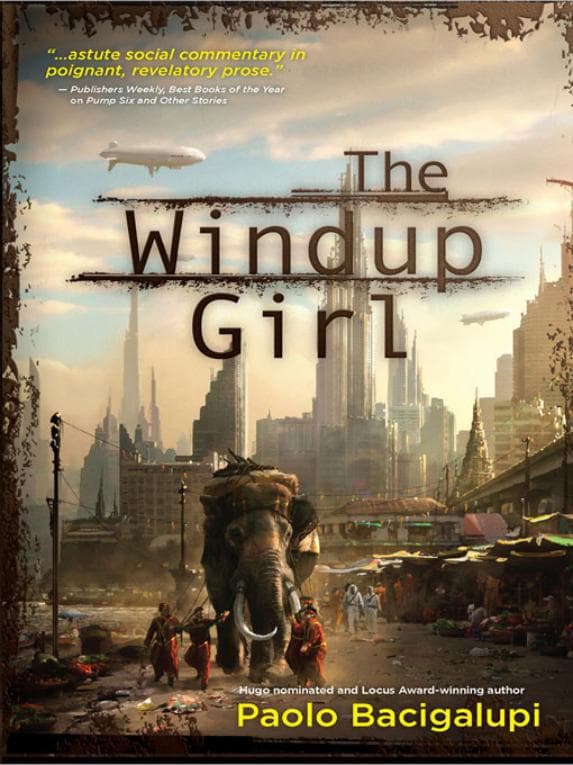
The Seedbank at the End of the World
Bacigalupi's Bangkok is a city that sweats. The megodonts turn their cranks, the calories are counted like currency, and the sea presses against walls that everyone knows will eventually fail. Published in 2009, *The Windup Girl* arrived at a moment when climate fiction was still earning its genre suffix, and genetic engineering was mostly a concern of Monsanto lawsuits and European labeling debates. Seventeen years later, the novel reads less like speculation and more like a dispatch from a timeline adjacent to our own — one that took a slightly different exit off the same highway. The calorie economy never materialized in the specific form Bacigalupi imagined, but the logic underlying it — that food systems would become vectors of geopolitical control, that seed sovereignty would be a matter of national security, that corporations would patent life and then litigate its reproduction — has only sharpened. CRISPR arrived five years after publication and made the genehacking he envisioned not just plausible but cheap. The novel's "calorie companies" look less like fantasy and more like the logical endpoint of trends that Bayer-Monsanto, Syngenta, and Corteva have been quietly pursuing. When Bacigalupi wrote about nations guarding seedbanks as strategic assets, the Svalbard Global Seed Vault had been open for barely a year. Now it has been accessed in earnest, and the geopolitics of germplasm are no longer subtext.
What the novel got wrong, or at least couldn't see, is the shape of the information economy that would coexist with any future resource crisis. Bacigalupi built a world where physical calories are the dominant currency of power, where kink-springs store energy mechanically, where the digital layer of civilization has largely receded. This was a deliberate aesthetic choice — biopunk rather than cyberpunk — but it leaves a conspicuous void. There is no internet in this Bangkok. No algorithmic surveillance, no social media accelerating the political crises that consume the novel's second half. The coup that unfolds over the final chapters would, in any 2026 analog, be livestreamed, hashtagged, and subject to real-time disinformation campaigns. The absence of digital infrastructure makes the political intrigue feel almost classical in its mechanics — messengers, whispered alliances, physical documents hidden in safes. It borrows its conspiratorial grammar from Bujold's *Barrayar* more than from anything resembling contemporary power struggles. This is not a flaw, exactly, but it is a tell. Bacigalupi was a writer of 2009, and in 2009 the most frightening futures were still biological, not computational. The coming wave, as Suleyman would later frame it, was supposed to be one thing or the other. It turned out to be both at once.