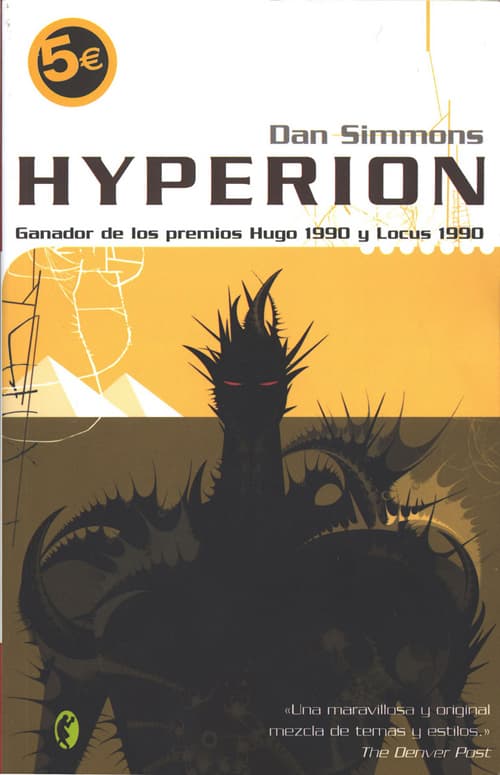
The Cathedral That Runs Backward
Thirty-six years on, Hyperion reads less like a novel and more like a diagnostic. Simmons built a universe in which humanity had scattered itself across hundreds of worlds, connected by instantaneous farcaster portals and governed by an AI collective called the TechnoCore whose true motives remained opaque to its human dependents. In 1990, this was furniture for a space opera. In 2026, it is a reasonably accurate sketch of our relationship with algorithmic infrastructure we cannot audit. The TechnoCore's quiet parasitism — using human neural networks as processing substrate without consent — anticipates the way large language models trained on the sum of human expression now generate value whose distribution remains, to put it gently, contested. Simmons didn't predict the internet. He predicted something worse: a symbiosis in which the junior partner doesn't know it's junior.
The novel's structural gambit — six tales told by pilgrims en route to an encounter none of them expect to survive — borrows from Chaucer and Boccaccio, but the inheritance that matters more is from Farmer's *To Your Scattered Bodies Go* and Card's *Speaker for the Dead*, both of which insist that the act of narrating a life is itself a moral event. Simmons took that premise and weaponized it. Each pilgrim's story refracts a different genre (military SF, literary fiction, detective noir, theological horror) and a different anxiety about what technology does to the things humans care about most: faith, memory, art, love, parenthood. Sol Weintraub's tale — his daughter aging backward, losing one day of memory each night — remains the most devastating section of the book, and it has only gained weight. In an era of widespread neurodegenerative disease, of families watching parents and partners forget them in real time, Rachel's condition no longer feels like a science-fictional conceit. It feels like a clinical description wearing a mask.
What Simmons got wrong, or rather what he couldn't see past, is instructive. His future is still essentially imperial. The Hegemony operates as a parliamentary body modeled on familiar Western democratic structures, and the Ousters are the barbarians at the gate — a framing that maps neatly onto late-Cold-War anxieties about civilizational collapse but misses the more diffuse, networked, asymmetric conflicts that define our actual present. The gender politics are uneven; Kassad's tale in particular treats its female figure, Moneta, as a projection surface for male desire wrapped in temporal mystery, and Brawne Lamia, the detective, is given more agency but still orbits a dead man's consciousness. The absence of any serious engagement with climate catastrophe is notable — Earth has been destroyed in this timeline, but by a "Big Mistake" involving a black hole experiment, a clean technological apocalypse rather than the slow, systemic, thermodynamic one we're actually living through. Simmons imagined humanity might die of hubris. He didn't imagine it might die of indifference.