The Mine Foreman's Bible
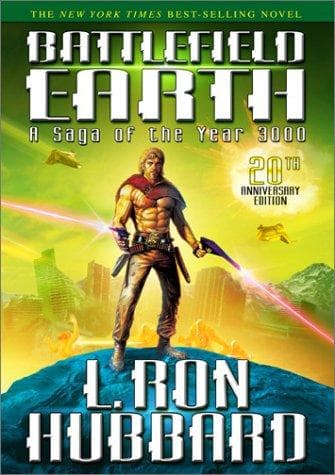
There is something almost geological about returning to *Battlefield Earth* in 2026 — like finding a fossil that looks more like the present than it should, and less like it than its admirers claim. L. Ron Hubbard's 1,050-page doorstop arrived in 1982 as a self-conscious throwback, a deliberate invocation of the pulp era he'd helped populate four decades earlier. He said so himself in the introduction, name-checking John W. Campbell Jr. and drawing a bright line between science fiction and fantasy, as though the genre's legitimacy depended on that border wall. The novel that followed — humanity enslaved by the Psychlos, a race of alien strip-miners who've spent a millennium extracting Earth's mineral wealth — was never subtle. It was not trying to be. What it was trying to be was a yarn, and on those terms it mostly delivers, provided you don't mind a protagonist named Jonnie Goodboy Tyler.
What the book did anticipate, with a bluntness that now reads as almost diagnostic, is the logic of extractive colonialism taken to its planetary endpoint. The Psychlos don't hate humanity. They barely notice it. Earth is a balance sheet entry, a resource node in an interstellar mining concern. In 2026, after two decades of discourse around rare earth dependencies, lithium scrambles, deep-sea mining proposals, and the geopolitics of cobalt supply chains, the Psychlo model feels less like space opera and more like a corporate org chart with extra steps. Hubbard also grasped something about the fragility of knowledge — his post-apocalyptic humans have lost nearly everything, and Jonnie's arc is essentially a crash course in reverse-engineering a civilization from its library. That thread resonates in an era of AI-generated slop, decaying digital archives, and genuine anxiety about whether anyone still knows how anything works. The book's faith that a sufficiently motivated individual can teach himself advanced physics from old textbooks is charming, and possibly the most dated thing in it.
The blind spots are enormous and predictable. Women exist in *Battlefield Earth* primarily to be captured, rescued, or admired from a middle distance. The political economy of the post-liberation world is handled with the confidence of someone who has never doubted that the right strongman, given the right leverage, will sort things out. Hubbard's aliens are capitalists of the most cartoonish variety — their entire civilization runs on profit motive and blackmail — but the critique never deepens beyond caricature. There is no internet, no networked communication, no sense that information itself might be a contested resource rather than a static thing sitting in a vault. The novel imagines humanity's great challenge as physical and martial. It cannot imagine that the harder problem might be epistemic: not *can we learn what we've lost*, but *can we agree on what counts as knowing*. The absence of any ecological consciousness is also striking. Earth has been strip-mined for a thousand years, but once the aliens leave, the planet is treated as essentially fine. Recovery is logistical, not biological.