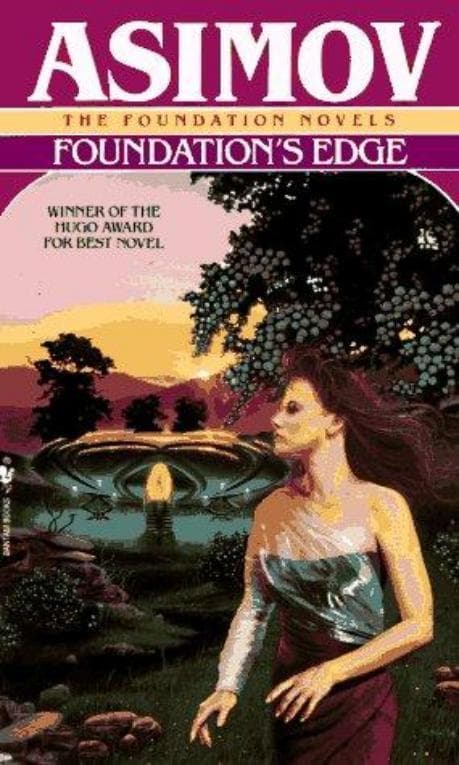
The Algorithm That Wanted to Be God
Forty-four years on, Foundation's Edge reads less like space opera and more like a policy memo from a civilization that has already lost the argument about whether to hand its future to a predictive model. Asimov's psychohistory — a mathematical engine that digests the behavior of trillions into probabilistic trajectories — was speculative sociology in 1982. In 2026, it is a crude but recognizable ancestor of the algorithmic governance systems we actually live under. Not Hari Seldon's elegant equations, exactly, but the same foundational wager: that populations are more predictable than persons, that the arc of large-scale human behavior bends toward computability. What Asimov anticipated with startling clarity is the political crisis that follows. Trevize's central suspicion — that the Seldon Plan is working *too well*, that its perfection implies hidden manipulation — mirrors the unease now commonplace among citizens who sense that recommendation engines, predictive policing models, and economic forecasting tools are not merely observing the future but constructing it. The book's most prescient insight is not the existence of psychohistory but the paranoia it breeds. When the plan works, nobody trusts it.
What Asimov could not see, or chose not to, is the texture of the manipulation itself. The Second Foundation's mentalic control — adjusting emotions, nudging decisions at the individual level — is rendered as a kind of psychic surgery, clean and bilateral. There is a manipulator and a manipulated. The messier reality of 2026, where influence operates through attention economies, microtargeted content, and feedback loops that blur the line between persuasion and environment, has no analog in his universe. Asimov's model of covert power is hierarchical: a small cadre of Speakers pulling strings from Trantor. He did not imagine a world where the strings pull themselves, where the system of control is diffuse enough that no one sits at the center. The Second Foundation is, in this sense, a comforting fantasy — the idea that if someone is steering, at least someone is responsible. The absence of women from any meaningful decision-making role, the frictionless homogeneity of galactic culture, the complete irrelevance of religion, art, or ecology to the fate of civilizations — these are not minor oversights. They are the silhouette of 1982's assumptions about what matters in history.
Gaia, the planetary superorganism that emerges as the book's third option, hits differently now than it could have in Reagan's America. In 1982, a collective consciousness voluntarily subsuming individual identity into a harmonious whole would have read as either utopian hippie fantasy or Soviet nightmare, depending on your politics. In 2026, it reads as a parable about networked intelligence — about what happens when every node is connected, when the boundary between self and system dissolves. Gaia is not the internet, but it rhymes. The choice Trevize faces at the novel's climax — between the First Foundation's technological individualism, the Second Foundation's elite mental control, and Gaia's radical interconnection — maps uncomfortably well onto the actual options currently being debated in boardrooms and parliaments: decentralized innovation, technocratic governance by those who claim to know better, or some emergent collective intelligence we don't yet have a name for. That Asimov frames this as a choice at all, rather than an inevitability, remains the book's most generous gesture.