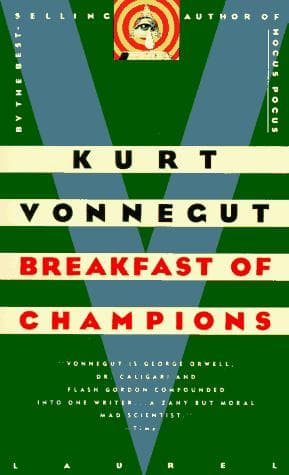
The Owner's Manual Was in the Glove Box the Whole Time
Vonnegut wrote *Breakfast of Champions* as a fiftieth birthday present to himself — a deliberate emptying of the attic, a yard sale of characters and obsessions. He told us this upfront, which critics at the time took as license to call the book self-indulgent, slight, a falling-off from *Slaughterhouse-Five*. Fifty-three years later, the book reads less like a clearance sale and more like a diagnostic manual that arrived decades before the disease fully presented. The central conceit — a man reads a text that tells him he is the only being with free will and everyone else is a machine, then acts on that belief with violence — is no longer absurdist satire. It is a recognizable pattern. We have watched, repeatedly, what happens when a person becomes convinced that other people are not real, that the world is a simulation staged for their benefit, that the NPCs deserve what they get. Vonnegut located this pathology not in ideology or religion but in loneliness, bad chemicals, and a piece of writing encountered at the wrong moment. He was more right than he could have known. The specific vector he identified — a book — now looks quaint beside algorithmic radicalization, but the mechanism is identical: a vulnerable mind meets a totalizing narrative that flatters it into monstrousness.
What the novel anticipated with eerie precision is the texture of American decay rather than its specific technologies. The poisoned creek coated in industrial plastic. The strip of fast-food restaurants and car dealerships that constitutes civic space. The Holiday Inn as the last neutral ground, the only architecture designed to feel like nowhere, which is the only place left that doesn't feel hostile. The way Dwayne Hoover's wealth insulates him from consequences right up until it doesn't. The way Wayne Hoobler, the young Black man just out of prison, orbits Dwayne's car dealership like a satellite with no planet, wanting nothing more than to be allowed to work, and is never even seen. Vonnegut described a country where the physical environment had been so thoroughly monetized and degraded that it could no longer support meaning, only commerce. He described West Virginia as a collapsed landscape, its mountains sliding into the holes men dug in them. In 2024, East Palestine, Ohio — not far from Vonnegut's fictional Midland City — watched a train full of vinyl chloride burn and poison the creek. The novel didn't predict that event. It described the conditions that made it inevitable, and the governmental indifference that made it unsurprising.