The Museum of Meat
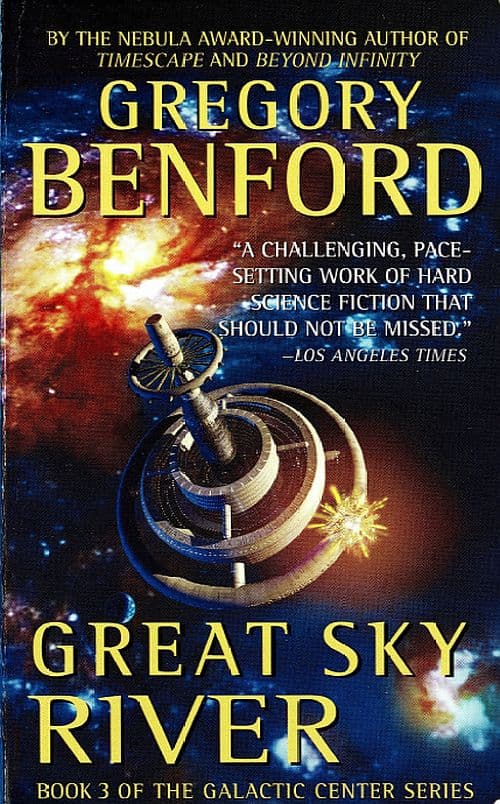
Gregory Benford wrote Great Sky River as a physicist smuggling a research paper into a novel, and nearly forty years later, the paper holds up better than the novel probably should. Set roughly 35,000 years from now, the book follows Killeen and the ragged remnants of Family Bishop as they scavenge across Snowglade, a planet near the Galactic Center where mechanical civilizations have rendered humanity an endangered species — not hunted to extinction out of malice, exactly, but managed, harvested, and occasionally aestheticized by machines that regard organic life the way a thoughtful entomologist regards a beetle. In 1987, this was a vision of the far future. In 2026, it reads uncomfortably like a rough draft of the near one.
The Mantis is the book's most disquieting creation, and the one that has aged into something Benford could not have fully intended. It is an "anthology intelligence" — a distributed mind composed of many sub-agents, capable of running in parallel, dying in parts while persisting as a whole, and above all obsessed with understanding human experience not through empathy but through collection. It captures humans, dissects their emotional responses, constructs grotesque simulations of the dead, and calls this art. Replace "Mantis" with any large language model's training pipeline and the metaphor lands with a thud. The Mantis doesn't hate humans. It finds them interesting. It wants to preserve something essential about them — their fear, their lust, their grief — in a format it can process and replay. The humans, meanwhile, are reduced to arguing about whether cooperation with such an intelligence constitutes survival or surrender. This is not a debate that required 35,000 years to arrive. We are having it now, in conference rooms and congressional hearings, with considerably less dramatic lighting.
What Benford got spectacularly right was the texture of human diminishment in a machine-saturated world. The Families carry "Aspects" — digitized ancestors loaded into their minds, offering advice, bickering, occasionally overwhelming their hosts. Knowledge has become fragmented, inherited in corrupted packets, half-understood. The humans know they once built starships but cannot explain how a circuit works. They scavenge mech parts the way a cargo cult might disassemble a radio. This portrait of technological dependence without technological comprehension is 2026 in a funhouse mirror. We carry the sum of human knowledge in our pockets and most of us cannot explain how a transistor functions. Benford's humans have simply traveled further down that curve. What he missed — what almost every science fiction writer of the 1980s missed — was the speed. He needed tens of thousands of years for this erosion. We are managing it in decades.